Eileen R. Tabios is a poet working in multiple genres and in-between. She also loves books by writing, reading, publishing, critiquing, romancing and advocating for them. This blog will feature her bibliophilic activities with posts on current book engagements and links to her books and projects related to books.
Showing posts with label Filipino Poetry. Show all posts

Monday, March 27, 2023

FEATURED ON MARSH HAWK PRESS' "CHAPTER ONE" SERIES

You are invited to read my' essay on titling poems, the latest installment in Marsh Hawk Press' "Chapter One" series! 

The essay deliberately references poet-activists Kerima Lorena Tariman (pictured above) and Ericson Acosta because, yes, their murders should never be forgotten. Essay available HERE. Here's an excerpt:

"... much of my job as a poet takes place before I begin any poem. My job is to educate myself on as many topics as possible, engage in a wide variety of experiences, hone my skills at observation, and meditate over the significance of a variety of events—not for writing a poem but by being better in the world through a basking in experience. All this knowledge and experience are filed in my brain as raw material for when I finally write the poem, e.g., the information on Negros Occidental which had marinated in my mind for three decades. In the actual creation of the poem, I trust in having filed enough mental material for the poem to access as it chooses.

Obviously, the more content there is in that mental file, the better the poem is served. I recently noted in an interview that as a poet I believe in education for education’s sake for avoiding cliches and sourcing new metaphors. As an example, for no particular reason besides education, I learned about black holes, specifically that if one is able to witness the phenomenon, one would see objects falling into those holes in falls that seem never to end. The idea of a permanent falling resonated with me and came to be included in several poems."

~

The article also provides a link to my next book BECAUSE I LOVE YOU, I BECOME WAR. It's not scheduled for release until May, but SPD now has it available for purchase HERE.


Wednesday, July 28, 2021

HOTEL PACOIMA by MICHAEL CAYLO-BARADI

Some poets lurk—simmer—under the radar. But when their poems are so good, they come to my attention even as I remain as reticent about my recognition as they are about pushing themselves into the spotlight. That’s what’s great about a book—a book can give (me) the opportunity to sing praise on their behalf. I do that for Michael Caylo-Baradi’s debut (I assume it’s his debut) poetry collection, HOTEL PACOIMA. I read it and was stunned, but in a way I’d anticipated. He solidly grasps the ineffable: masterful at not just objectifying but eroticizing language into flesh itself, sagacious when it comes to observing culture, easily offers a textured diction that often lapses into the delicious, and (and this is difficult to articulate) proffers a sense of some rapprochement with life, such that it ultimately makes sense that he offers Anita Brookner through an epigraph including “…at last I understand that acceptance is all. I succumb to the genius of the place, and know true felicity. The sun is God. Of the rest it is wiser not to know, or not yet to know.” Dear Reader, I counsel you RUN to get this book.


A Sample Poem:


Tuesday, December 8, 2020

PA-LIWANAG: TO THE LIGHT (FILIPINAS IN TRANSLATION)!


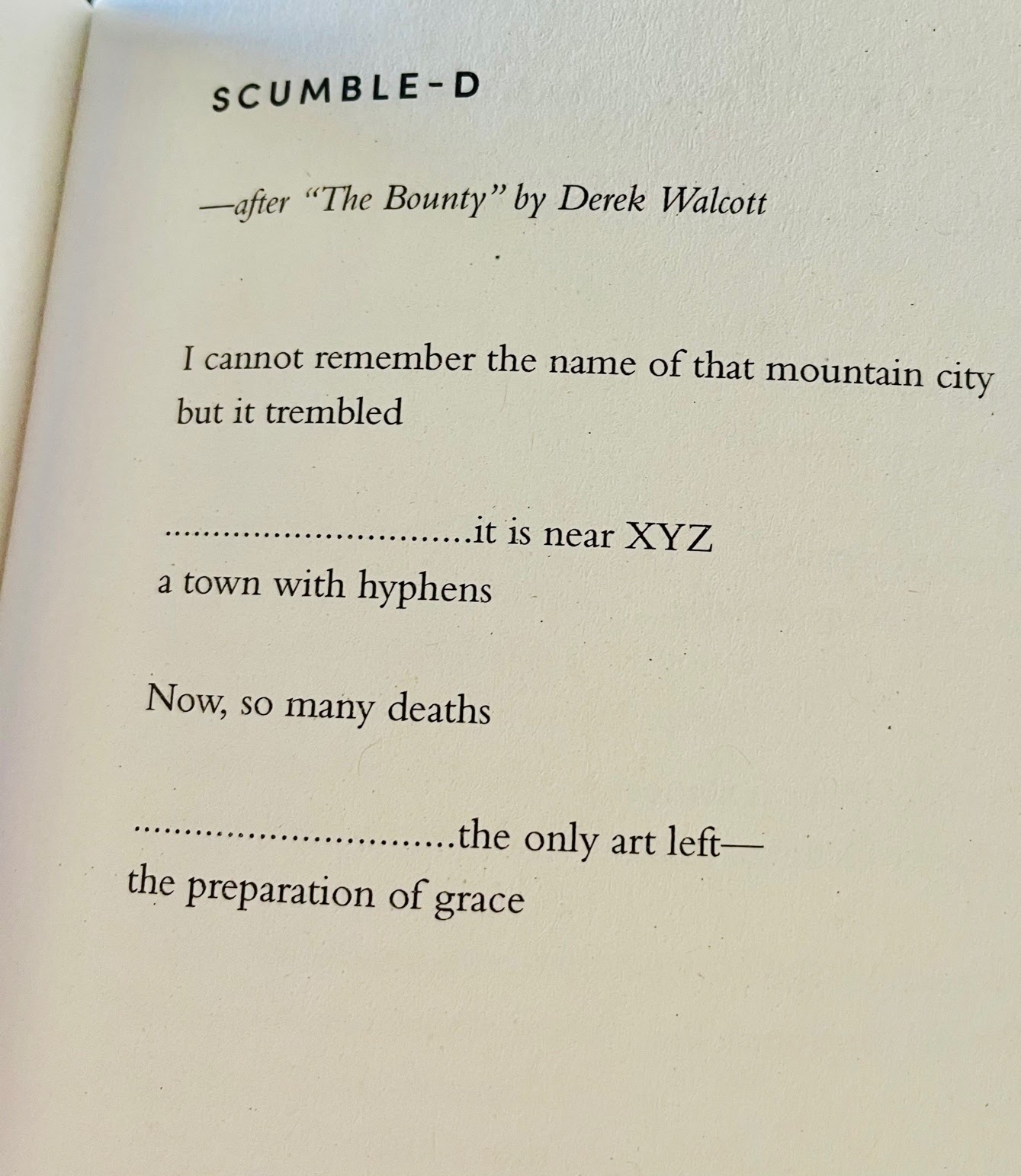
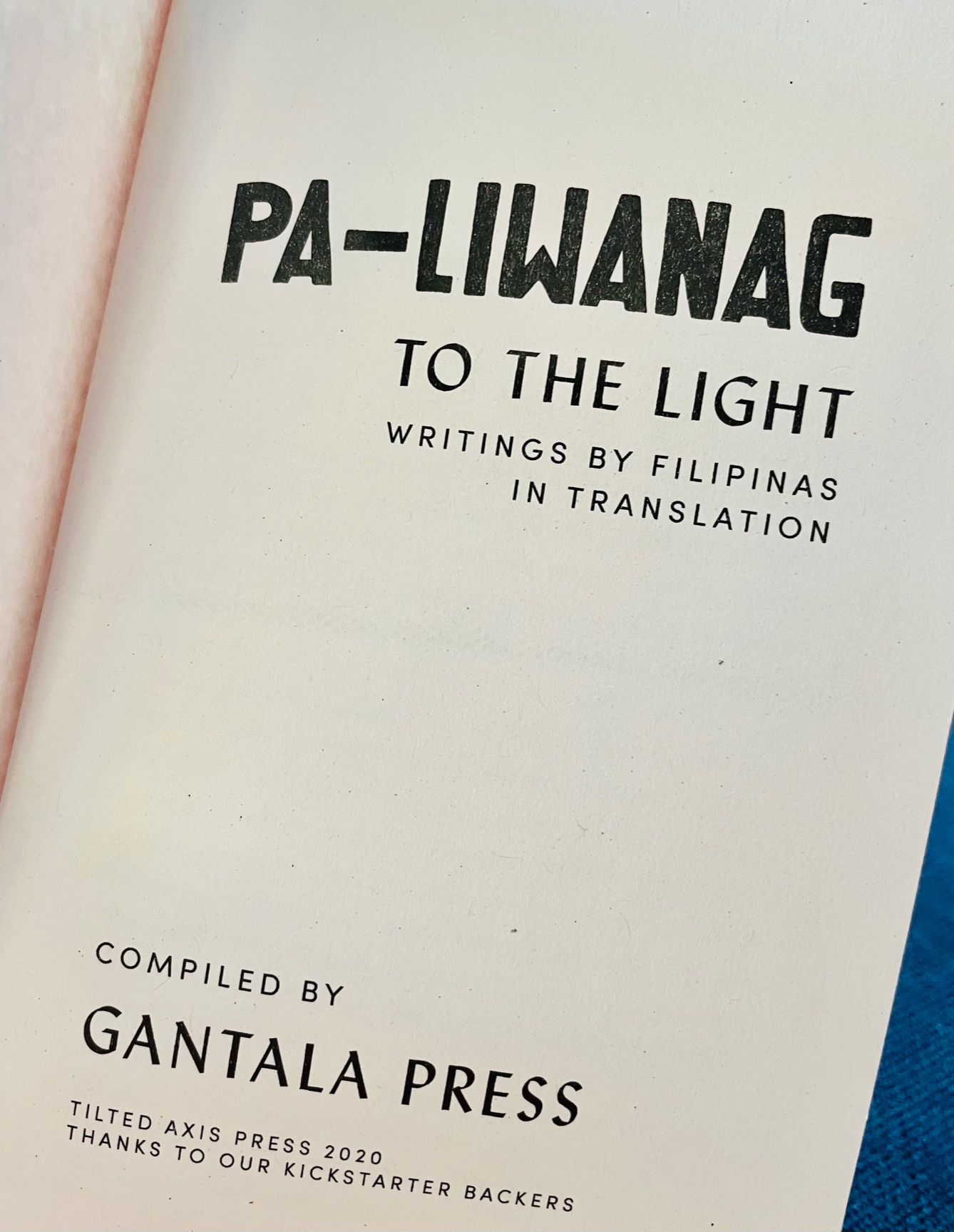
I just received a copy of a new anthology featuring my works. It's a project that shows indie publishing at its best--you can see by the first 2 pages of its Introduction that I share, and from which I share this powerful excerpt below. PA-LIWANAG is published by the Philippines' Gantala Press and picked up for further publishing support by the U.K.'s Tilted Axis Press. I share my 2 poems ("Scumble-d" and "The First Face Transplant") since I shouldn't share others without their permission--though I will note that I am blessed to discover new poems and poets (I adore "Puki" by Elizabeth Ruth Deyro, a poet from the province of Laguna). Gantala asks:


"When a government wages war against its people -- surely a woman's press can and should do more than just publish books?"


Thus Gantala publishes "the works of women farmers, plantation workers, nurses and migrant workers, and regularly contributes to fundraising efforts in support of factory workers on strike as well as urban poor communities." This book is one of them and I'm honored to be in their company.


Friday, May 8, 2020

DAY 6/7 FOR MINIATURE BOOK SOCIETY


I’m a new member of the Miniature Book Society and I was nominated to post 7 books for MBS’ Facebook page. "Miniature" books are sized at 3-4 inches or less. I’ll be replicating the posts on this blog for the next 7 days.


DAY 6/7  My favorite miniature book covers

MBS

I’m sharing books by some of today’s contemporary poets. My sixth presentation is of a family-oriented series, books by Melinda Luisa de Jesus and her children Malaya (8-years-old) and Stinson (13-years-old). While Melinda is a noted feminist/peminist scholar, she is also an artist/poet who raises her children accordingly. In recent years, Melinda underwent training in the letterpress arts at the San Francisco Center for the Book where she studied with Mary Laird and became certified to use the Vandercook cylinder press; she started her own press, "Latenight Letterpress/peminology." She printed these three books published by Minitage Editions entitled MANGOS (by Melinda), SPAM (by Stinson), and MERMAIDS (by Malaya). These are all 3 x 3 inch accordion books handprinted from polymer plates on Stonehenge and Nepali paper.

All of the poems are in the Filipino diasporic “hay(na)ku” form that is based on three lines with the first line being one word, the second line two words, and the third line three words. It’s, thus, nifty that the authors also number three! As well, I present the hay(na)ku and this Filipino-Pennsylvania Dutch family because it’s Asian and Pacific Islander Heritage Month here in the United States and Melinda is a Filipina-American with Pilipinx kids.


 *
Today I nominate any new member of MBS. I love seeing all the books already shared, AND I’m also interested in the *gateway* books—those that made you discover mini books or the first books you’re collecting. Some of the books I’m posting, for example, were created before I knew that miniature books were a thing. So I nominate MBS New Member #6.
*****
This is a challenge for contributing to the spread of reading culture. The method of participation is to post a favorite book, one book per day, for 7 days. You upload some images with a short explanation about the book and invite one FB friend to participate in this challenge.


Friday, December 6, 2019

HOW TO TEACH ME


I recently sent books to a professor of Asian American Literature who will be teaching some of my poetry. Along with the books, I dashed off the following (very informal, not scholarly) note ... which I then thought to share here as it may be helpful to others. The note is slightly contextualized for AsianAm Lit but I believe can be relevant to other disciplines:

[DEAR TEACHER],

            Thanks for your receptivity to my work. I thought I’d share some notes since I’m sharing several books that may (or may not) be helpful for purpose of “Asian American lit”:

--you have Reproductions of the Empty Flagpole and it shows how I use abstract language to elide the use of English as narrative communication, as a dis at how English was used to colonize the Philippines. My transcolonial take on language is reflected on how I deliberately radicalize the slipperiness of language (for which Poetry’s language is so perfect)—such is seen as well on MURDER DEATH RESURRECTION (which maximizes the role of randomness in creating new poems).

--2019 book Witness in the Convex Mirror reflects a nod to John Ashbery for being called (in some circles) the most important English-language poet of the 20th century) but my attempt (particularly in 2nd half of book) also “browns" his concerns.

--the hay(na)ku books add a new poetry form to English poetry, which was both an aesthetic and political goal.

--I like using methods associated with the visual arts because I’m trying to address poetry in non-traditional ways. SUN STIGMATA reflects my “sculpting” out new poems from the text blocks that had appeared in Reproductions of the Empty Flagpole. This also led to my “Selected Visual Poetry,” THE GREAT AMERICAN NOVEL (GAN); the title of course also addresses the notion of not just GAN but “AMERICAN.” GAN’s first entry may be of most interest as it reflects how I translate diaspora into “cloudygenous,” a word I invited for a Univ. of Wesleyan anthology of new words related to the anthropocene…

--The Secret Lives of Punctuations brings out to light those items (punctuations) often ignored—a metaphor for … many things. Note the reference to “Vol. 1” though there aren’t (yet) additional volumes to indicate the plentitude of life in the margins. Relatedly, Menage a Trois with the 21st Century seeks to resuscitate a modern life for Gabriela Silang who had sacrificed her life to be the first female general of anti-Spanish colonial forces in the Philippines.

--ECSTATIC MUTATIONS: Experiments in the Poetry Laboratory is an old and out-of-print book published in the Philippines but is useful for relaying my early interests in experimenting with poetry. TANKA, Vol. 1 (relatively new work) indeed shows me revamping the traditional “tanka” form.

--it’s tedious being a martyr so I TAKE THEE, ENGLISH, FOR MY BELOVED is also a  rapprochement with my reality of being a diasporic Filipina writing in English. It was a lot of fun to marry English and that performance also involved  other poets, including a hairy poet, wearing that over-the-top Princess Di type of bridal gown (once, it was the rage J ) featured on the book cover.

--I TAKE THEE, ENGLISH,… includes reports on performances involving the community. Such acts, along with the hay(na)ku, MURDER DEATH RESURRECTION, and others will reflect—ultimately—my encouragement of “Kapwa” (a Filipino indigenous trait of recognizing one's self in others and vice versa).

--I love doing “Selected Poems” projects on poetry forms as such allows me to show—and interested readers to glean—how I expanded a poetry form’s possibilities: hence, Invent(st)ory on the list poem; Great American Novel on visual poetry, A THORN ROSARY on the prose poem, and even ONE TWO THREE where I did a Selection on the hay(na)ku despite inventing it (it led to the “haybun,” among other things). 147 MILLION ORPHANS is the first and so far only single-author collection of haybun. As a Filipino-PilipinZ writer, I consider it important to be discernible in not just inheriting but expanding the English language.

--The Blind Chatelaine’s Keys and AGAINST MISANTHROPY may be useful for offering poetics essays. Note that quite often I use not my own authored essays but others’ to reflect Kapwa and because I believe it’s my job to create poems but not necessarily tell others how to read/interpret them. These two also reflect my performance-disputations of auto/biography—the difficulty of capturing reality (e.g. through multiple interpretations of my work). This element is noted in the subtitle of THE LIGHT SANG AS IT LEFT YOUR EYES which incorporates the word “our” before the word “autobiography.”

More info on my poetry books are at my website, specifically https://eileenrtabios.com/poetry/

All best,

Eileen
Enclosures:
THE THORN ROSARY: Selected Prose Poems & New (1998-2010)
INVENT(ST)ORY: Selected Catalog Poems & New 1996-2015
The In(ter)vention of the Hay(na)ku: Selected Tercets 1996-2019
The Great American Novel: Selected Visual Poetry (2001-2009)
Menage a Trois with the 21st Century
The Secret Lives of Punctuations, Vol. 1
MURDER DEATH RESURRECTION: A Poetry Generator
Love in a Time of Belligerence
Witness in the Convex Mirror
Sun Stigmata (Sculpture Poems)
147 Million Orphans
AGAINST MISANTHROPY: A Life in Poetry (2015-1995)
THE BLIND CHATELAINE’S KEYS
THE LIGHT SANG AS IT LEFT YOUR EYES: Our Autobiography
I TAKE THEE, ENGLISH, FOR MY BELOVED
ONE TWO THREE: Selected Hay(na)ku (English/Spanish bilingual edition)
ECSTATIC MUTATIONS: Experiments in the Poetry Library
TANKA, Vol. 1


Monday, October 28, 2019

DELIGHTED TO BE IN ELLE, ITALY FOR FEMINISM!

Gratitude to Elisabetta Moro for her article, "Onore E Rispetto Per Le Donne Filippine, Il Cui Femminismo È Pura Poesia Di Resistenza," in Elle magazine, Italy. I don't know Italian so here below is a Google translation :)

“Honor and Respect for Philippine Women, Whose Feminism Is Pure Poetry Of Resistance”

Feminism is many things: it is struggle, it is sisterhood, it is questioning oneself, it is telling oneself and communicating. There are a thousand ways to contribute to the cause and creativity is a powerful tool, never to be underestimated. On this we have much to learn from Filipino women because, over the years, their feminism, as well as enriching themselves with battles and political victories, has fed on literature, art, but above all, poetry.

In the Pacific islands women have always actively participated in public life: from the pre-colonial phase, when the female figure of the babalyan (a sort of shaman with healing powers) acted as a spiritual guide for the community, during the period of Spanish domination, when many women have joined the struggle for independence; from the Second World War, which made Filipino women victims of atrocious violence, after the war, which saw them organize themselves into a movement that over the years has become increasingly strong.

Filipino feminism, therefore, is inextricably intertwined with the country's colonial past, as well as the strong tensions and class disparities that characterize it. However, it also has another characteristic: it knows how to amplify women's voices to launch important messages and, to do so, it uses literature and, in particular, has a close connection with poetry. Whether it's talking about independence from colonial rule, stereotypes, violence and patriarchal society or freedom and pursuit of one's own female identity, Filipino women have never pulled back, using their own verses as a tool for social struggle. The landscape is vast: from the mid-1900s poets like Angela Manalang Gloria or Marra Lanot - who have put in the verse the frustration of having to look like a perfect and unreal female model - to contemporaries, like Barbara Jane Reyes and Eileen R. Tabios.

The result is a cultural background that has roots in the past, but continues in the present and that constitutes the soul of the movement, its most intimate part. Precisely for this reason the independent publishing house Gantala has decided to protect this heritage, recognizing its cultural and political value. "We want to promote poetry and essays as research, investigation and documentation tools. We do not want these forms to be exclusive to writers, academics and award-winning artists who have participated in "prestigious" national seminars, "explained co-founder Rae Rival. The project is openly feminist, but it also has a strong link with the rural world according to the principle dear to Rival that "the feminist struggle goes hand in hand with the struggle of the people".

Of course, the road to equality, in the Philippines as in the rest of the world, is still long. Demonstrations, strikes and political battles will be needed, but the value of words should not be forgotten. Poetry can be the means - personal and profound - to express anger and pain, to support each other, to resist, to fight.

Thursday, June 20, 2019

EXTREME TEXTS

The long-awaited  “Extreme Texts” feature at Jacket2 edited by brilliant scholar-poet Divya Victor is out! And I’m pleased to be a part through MURDER DEATH RESURRECTION’s exploration of kapwa, transcolonialism, cubism/abstract expressionism, mathematics, subjectivity, weariness, a Pacita Abad painting, the illusion of the random, and, always-and-forever-for/from-me: Poetry. Here's my essay.

I heartily recommend reading through the entire issue as some of the most innovative work—innovative thinking—in contemporary poetry is presented here. Here’s link to the editor’s Preface with Table of Contents on the right side: http://jacket2.org/feature/extreme-texts

I am particularly heartened (I hadn’t expected it) that my work is presented in the same issue as a “Philippines Dossier”—as Angelo V. Suarez calls it with his intro, “Philippine literary production under fascism.” I am reminded of a leading Filipino poet who’d recently contacted me about publishing a book here in the U.S.—because while they normally would be able to publish it in the Philippines, it includes anti-Dut poems and that would make it difficult for such a publisher. (Relatedly, there are implications to how such a Dossier ends up being in Jacket2, a non-Filipino pub except for how cyberspace encompasses global of course)

Much to read. Much to consider. Do join me in perusing.

[Thanks to Carol Dorf and Leny Strobel and the Babaylan Files for their help with my essay. And Tom Beckett--I continue to give credit to the inspiration of your book DIPSTICK/DIPTYCH.]


Friday, January 25, 2019

SALAAM MATS, PAOLO MANALO


Mail del dia is the chap E IS FOR EPAL from Paolo Manalo of Jolography fame. I expected to laugh, and I did, at his fabulous wordplay... but when his brief collection must include a poem like “Annus Horribilis,” it just shows the direness of the current regime. The poet doesn’t turn eyes away, forcing humor to come harder and harder.


Sunday, September 9, 2018

HAPPY 15TH BIRTHDAY, HAY(NA)KU!!!


We actually sang "Happy Birthday" to the hay(na)ku! This was not your typical poetry reading or book launch but a literary quinceanera!

Thank you. I am so grateful to those who helped plan and formed the Hay(na)ku Birthday Celebration Sept. 8 at the San Francisco Public Library – from the crowd of attendees to those who helped bring the food and books because I live out of town, the dancers, the sponsors, the readers…Salamat Abraham Ignacio, Edwin Lozada, emcee Abigail Licad, baker and mom-to-dancers Melinda Luisa de Jesus, dancers Malaya and Stinson, and readers listed below.

There were also special features to the event: Abe Ignacio’s bibingka (to die for!); Melinda Luisa de Jesus’ mirror hay(na)ku sculpture which intrigued the crowd; celebratory champagne Jacquesson & Fils Cuvee Perfection released in 1998 to celebrate the 100th anniversary of the Philippines’ Independence (it was still good! Thanks Tom!). Anyway, I have no words to articulate the fullness of my heart. Here were the readers – special thanks to the readers who came in for this event from Toronto, Colorado, and San Diego:

Stewart Shaw
Gabby Bautista and Michelle Bautista
Melinda Luisa de Jesus and Malaya Lanikai de Jesús-Tinsman 
Aileen Cassinetto and Paul Cassinetto
Jean Vengua 
Tess Crescini
deb y felio 
Cesar Polvorosa
Carol Dorf
Amy Pabalan
John Bloomberg-Rissman
Sheila Bare 
Glynda Velasco
Sean Labrador y Manzano

Photos below are of the event and two associated exhibitions at the San Francisco Library: a permanent installation of five framed hay(na)ku posters and a 19-Poem exhibition of hay(na)ku, both on the library's third floor. It was fun to see event participants and attendees do "Kodakan" (Filipino slang for taking photos) in front of exhibits, especially the five-year-old Gabby Bautista who is the youngest poet in the HAY(NA)KU 15 anthology.  To Kodakan then! Click on images to enlarge:

 Eileen Tabios gratefully greeting the crowd (grateful for turnout despite huge traffic
constraints due to the Climate Change protest march).

Abraham "Abe" Ignacio, Jr.,  Librarian for the SFPL Filipino-American Center

Eileen and Abe in front of the 19-Poem Hay(na)ku Exhibit

  Edwin Lozada, founder of the Philippine American Writers Association


Michelle Bautista reading the poem of 5-year-old Gabby Bautista, the youngest 
poet in HAY(NA)KU 15 anthology. Gabby is behind the podium as she decided 
she didn't like the poem she published in the anthology, but wrote a new one
for her mom to read as well. 


Gabby's newer and preferred hay(na)ku poem.

Scholar-Poet-Soprano-Baker Melinda Luisa de Jesus sports hair matching her cake.

 Sheila Bare

 Abigail Licad


 Edwin Lozada mans the book table, and sells books!

A marvelous surprise: Abe Ignacio's bibingka--yummy! 

Melinda Luisa de Jesus with her hay(na)ku mirror sculpture. 

The crowd engaging with Melinda's sculpture, including John Bloomberg-Rissman 
who traveled from San Diego to do reading. 

deb y felio traveled from Colorado to read at the event. 

Amy Pabalan doing her first San Francisco reading through the hay(na)ku! 

Stewart Shaw 

Sean Labrador y Manzano 

John Bloomberg-Rissman who traveled from San Diego to do reading

Stinson and Malaya by Abe Ignacio's bibingka (as soon as we finished 
the photograph, we all leapt for a piece!)

 Jacquesson & Fils Perfection Cuvee Special Edition for "Independance Des Philippines"

 Melinda Luisa de Jesus reads the mermaid poem written by 8-year-old Malaya, 
while Malaya holds up her drawing of a mermaid.

 Cesar Polvorosa, Jr. brought his family from Toronto to read at the event.

Carol Dorf

Michelle and Gabby Bautista in front of Melinda's hay(na)ku mirror sculpture.

Glynda Velasco

 Melinda Luisa de Jesus counsels her kids Stinson and Malaya 
who performed the "Binasuan" folk dance to open up the proceedings.


 5-year-old Gabby signs her first book!


9-year-old Malaya signs her first book ... with a cat!


Glynda Velasco by her exhibited poem.

***

Five Framed Hay(na)ku Posters
--poems by Eileen Tabios, Vince Gotera, Jean Vengua, Abigail Licad, and Aileen Ibardaloza-Cassinetto:

Jean Vengua


Eileen and Abe

***

Kodakan with Gabby:

5-year-old Gabby gazes at her exhibited poem.

Rhett Pascual "Kodakan" his daughter Gabby.


Thanks again to everyone. If you're interested in seeing more, do check HAY(NA)KU 15 anthology (there currently is a September pre-release Special with discounted price) -- info HERE!