Eileen R. Tabios is a poet working in multiple genres and in-between. She also loves books by writing, reading, publishing, critiquing, romancing and advocating for them. This blog will feature her bibliophilic activities with posts on current book engagements and links to her books and projects related to books.
Showing posts with label DOVELION. Show all posts

Monday, February 6, 2023

MONSTER HIGH'S INVITATION TO POETRY

Philippine Bookshelf--through @yugto.bookclub on Instagram--is featuring my poem "Epiphany at Monster High" as part of their February Invitations to Poetry. I'll post poem in its entirety below because I don't know how to share it from Instagram to Blogger :)


Epiphany at Monster High


I realize

I like to rescue
Dolls

discarded by children
who grow old by forgetting 
Love

I dust them, shampoo
their plastic hair
(now a collection of split-ends)
and bathe their bodies
(many scarred by animal teeth)

When I rescue dolls
I revive their ghosts
who now bring me 

their language of longings

(fresh fodder to translate

for making new poems)—
I reciprocate

I clean their clothes
or give them new apparel

For one treasured skirt

I apply my inheritance

of Mom’s needle and thread

Most need new shoes

The ghosts cease crying
and masticating hapless tongues 
behind scarred stiff cheeks 

After sponge baths, smiles surface
from erased grit—most dolls 

are made with upturned lips

for they rationalize their existence

as conduits for joy, for Grace


I discover I like to rescue dolls
to rediscover 

how I love to rescue Love


Thursday, February 2, 2023

DOVELION AND "INDIGENOUS FUTURISM"


I'm pleased to share a unique review of my first novel DOVELION for situating it within "Indigenous Futurism." You can see the review HERE but it pleases me so much that I’m just reprinting below:


Transmotion Review by Denise Low of Baker University

(Accessible online through University of Kent’s open access journals site)


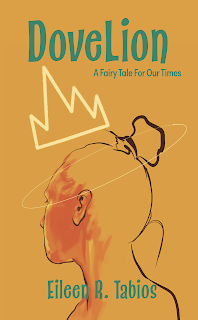
Eileen Tabios. Dovelion: A Fairy Tale for Our Times. AC Books, 2021, 309 pages. ISBN: 978-1-939901-19-4


https://www.acbooks.org/dovelion


Eileen R. Tabios' Dovelion is a slipstream work of fiction. It has characters, and a plotline develops, slowly, in the background, like a novel. Some of this work is fictional, some autobiographical. The central site is in an imagined place, Pacifica, which is supposedly connected to the Philippines (where Tabios was born before moving to the United States). But rather than autofiction, the narrative is a work of Indigenous futurism as it shifts among strands of transcolonial experience. "Transcolonial," not postcolonial, is the better term to describe the book's political critique, to suggest how imperial powers have dominated Indigenous peoples like those of the Philippines and how their influence continues and will continue in myriad guises globally. The author is simultaneously a rebel against erasure of Indigenous sovereignty and a visionary who offers new expressions of cultural traditions and personal wholeness. 


Indigenous futurisms writers generate literary and other artifacts that revise western European literatures. With her textual inventions, Tabios disrupts the expectations of English-language genres. Poetry, geography, political science, dialogue, prose poetry, culinary arts, visual art critique—all wend their way through the sequential and gradual unmasking of the characters in Dovelion. This is Tabios' method of character development. There is a through-line present in the novel-like book: a Marcos-like dictator and his family terrorize the populace and exploit the environment, until overthrown. Two lovers are children of enemies. The woman's pregnancy results in a child and then grandchildren who commingle bloodlines of the feuding families. Events occur and recur in the narrative fabric, like revisited memories. 


Tabios' body of work includes other experiments with form, including invention of the tercet form hay(na)ku. Several of these are embedded within the work: "When I bleed / I camouflage / tears" and "When I weep / I camouflage / blood" (71-2). Each diary-like section begins with a day and month, but no year. The dates are not sequential, but instead seem random. Tabios created a random language generator for her projectMurder Death Resurrection: A Poetry Generator (2018), so the nonlinear system for dates in Dovelion is consistent with the author's modus operandi. Jumbled dates suggest entry into an alternative time, where linear sequence is irrelevant. Like oral tradition stories, the same incidents repeat with varying emphases. Point-of-view shifts among characters. Thus, Dovelion's underlying scaffolding is a three-dimensional clothesline upon which to hang moments of all shapes and sizes.


All entries begin with the fairy-tale phrase "Once upon a time." The chapter entitled "12 April" illustrates one of the unexpected directions of the prose; it begins with reflections on the love affair and proceeds to a quotation from "the poet Eileen R. Tabios," who is, the narrator avers, "a strong influence on my work" (60). The book's narrator and author separate here and elsewhere and re-engage, as Tabios interrogates the act of authorship. 


Sequential chapters, one through twenty-five, order the book, an overlay on the randomly dated subsections. And Tabios further divides the book into three overarching sections that create another mapping: "There Was Is," "There Became Is," and "There Will Be Is." English verb tenses collapse into a single tense of presence. Time is a recurring concern of the book.


Decolonization through restructuring of language and genre is one dimension of Dovelion. Another is revitalization of Indigenous values. Tabios writes about her book Murder, Death and Resurrection: A Poetry Generator


I also wanted to deepen my interrogation (and disruption) of English which had facilitated twentieth-century US colonialism in my birthland, the Philippines. . . . I wanted to develop a consciously closer link to the Filipino indigenous value of "Kapwa." "Kapwa" refers to "shared self" or "shared identity" whereby everyone and everything is connected." (Jacket2, June 2, 2019)


Dovelion defines, explicates, reveals, and dramatizes the timeless value of "kapwa." A "nanny" first explains the term in the book as "despite diversity, One is All and All is One" (57). In another embedded quotation from the author's own writings, she explains a poetics that expands on the meaning of kapwa: 


The human, by being rooted onto the planet but also touching the sky, is connected to everything in the universe and across all time, including that the human is rooted to the past and future—indeed, there is no unfolding of time. In that moment, all of existence—past, present, and future—has coalesced into a singular moment, a single gem with an infinite expanse. (DoveLion 60, originally published in The Awakening, 2013)


The author also explains kapwa in terms of the science of physics, explaining that "it's not only a cultural belief. Various physicists have long proposed time is not linear. Some call time a dimension of spacetime and, thus, [time] does not pass because spacetime doesn't" (156). The theory is a praxis. The restoration of the intact, healthy culture is predicted by its onetime existence in the past. The Filipino child's tale "An emerald island sits upon a blue sapphire ocean and both glow under the beam of a 24-carat sun" is a continuous refrain throughout the narration and a continuous expectation.


Islands are a motif in Dovelion, from the invented island country of Pacifica to the Philippines to a "large grey building" where the two lovers meet in isolation. Each individual is a discrete "island" of individuality, which links to others through sex, children, and social relationships. Kapwa links each person. Unspoken is the John Donne poem, "No man is an island," but it is present nonetheless as all writings in all time exist simultaneously in Kapwa time.


Tabios does not allow decolonization principles to devolve into rhetoric without action. Rather, she previews a future where enemies reconnect in alliances against dictatorships. She shows how the restoration of a continuous concept of time corrects the fallacy of linear time, where the past falls off the left-hand edge of the page and can be ignored (like nineteenth-century US treaties with Indigenous nations). Tabios offers options. She recognizes June 12, the day the Philippines overthrew Spanish rule, through an imaginary website June12.com. She restores Indigenous values in new form. Dovelion is a blueprint for further investigations into a future where Indigenous knowledge structures the narratives.


Denise Low, Baker University


Works Cited:


Tabios, Eileen. The Awakening: A Long Poem Triptych & A Poetics Fragment. Theenk Books, 2013.


–––. "Murder Death Resurrection: Another Way for Poetry." Jacket 2. June 2, 2019. Murder death resurrection | Jacket2.


–––. Murder Death Resurrection: A Poetry Generator, Dos Madres, 2018.


Sunday, July 3, 2022

ON DOVELION, NOVEL-WRITING, AND, AS EVER, POETRY

I'm grateful that my first novel DOVELION (AC Books, New York, 2021) continues to receive attention more than a year after its release. Here are three examples:

DOVELION's book page presents links to reviews and reader-engagements. The latest review that came out today is by Allen Gaborro at The FilAm where he concludes

“DoveLion” does however have a saving grace other than the treasure of its poetry. The book indelibly illustrates the fertile spiritual and emotional struggle and affecting introspection taking place in its text. That’s something that the best of plots cannot accomplish on their own. 


I also was recently interviewed by Eulipion Outpost on creative writing, aging, Asian drama bingeing, and dolls. The article is illustrated one of two writing desks in my writing studio:


Finally, I'm glad to say that DOVELION has just finished being translated into Filipino by noted novelist-scholar-poet-editor Danton Remoto. I hope to share good news about it more in the future!


Monday, May 30, 2022

HOW TO BE A POET-NOVELIST viz MARSH HAWK REVIEW

Marsh Hawk Review consistently presents contemporary poets who are worth reading in part for how they expand the poetic terrain. For its just-released Spring 2022 issue, deep gratitude to editor Daniel Morris and prose editor Burt Kimmelman for including me in both the poetry and prose sections. Both of my contributions reflect my development as a poet-novelist. My poem (P. 47) is an experimental haibun that was written while writing my third novel. My prose contribution is an essay on “How a Poet Writes a Novel” (P. 58). I hope you check them out, along with other outstanding words and poets in the issue. Available at this link: https://marshhawkpress.org/the-marsh-hawk-press-review/

From “How a Poet Writes a Novel”, its opening sentence:

“What if, instead of having an idea for a story, you decide to let the world write your novel?”


The novel, of course, is my first novel which was released last year, DOVELION (AC Books, N.Y.).


Thursday, February 10, 2022

DOVELION, REVIEWED at UP THE STAIRCASE!


Deep gratitude to poet-essayist Elsa Valmidiano's new review of DOVELION: A Fairy Tale for Our Times. I'm reprinting entire review here from journal Up The Staircase as there seems to be an access problem with those who use Norton as their internet security (you can try to see review HERE):


The Battle Against Total Erasure: Review by Elsa Valmidiano.


From acclaimed poet, Eileen R. Tabios, comes her epic first novel, DoveLion: A Fairy Tale for Our Times, from AC Books, April 2021, a novel of erotic encounters, political intrigue, meta literary references, and ancestral/indigenous exhumation.

The fictional setting of Pacifica, many might argue, is a caricature of the Philippines itself, recovering from a Marcos-esque regime, or really any country that is still reeling from dictatorship trauma. This could very well include so many countries across the world, where present day’s Jair Messias Bolsonaro comes to mind and his aggressive moves to open up the Amazon rainforest to commercial development, threatening the current homes of Amazonian tribes, just as Ferdinand Marcos from 1972 to 1986 displaced 300,000 Moro people in Mindanao through a combination of “hamletting” and community takeovers, while refining extrajudicial killings against indigenous communities to help foreign mining corporations secure a foothold on their lands. Hamletting is the clearing of an area of an alleged rebel presence and maintaining a military presence to keep them out. Tabios paints such a caricature of Pacifica’s dictator, eerily reminiscent of the former dictator of the Philippines, Ferdinand Marcos himself. As one can additionally see today, despotic power is still evident during Rodrigo Duterte’s reign against the indigenous Lumad. And so the modern fairy tale, or shall we call it modern day history, goes on and on.

As evident in Tabios’ poetic prose, the strategic opening lines do not go unnoticed as she reiterates the echoed lines from paragraph to paragraph, “Once upon a time,” staging an irony as if the events in the novel reveal what is happening now, not far away, but now, so that “Once upon a time” becomes a poetic refrain of a story or song to be repeated and remembered. In its own way, the repetitious lines from her storytelling remind me of Filipino folk songs and ballads I grew up knowing, as if they are memory tools, so that in reading “Once upon a time,” Oral Tradition of our own nuanced ancient storytelling is reflected back at us, not memorialized in spoken word and song this time, but in written text.  

Between the erotic and vulnerable exchanges between protagonists, Elena Theeland and Ernst Blazer, Tabios not only captures the intensity of these would-be enemy-descendants, but poses the question, “How do descendants of enemies forgive, love, and move on?” Philippine history itself reveals this repeating betrayal among brown brothers, such as Diego Silang, a young Ilocano revolutionary leader who dared overthrow Spanish rule in the 1760s, and was killed by his own friend whom colonizing authorities paid to assassinate. And somewhere out there, the descendants of victims and executioners possibly coexist—in the Motherland? in the Diaspora? Could they be close friends, even lovers, and not know it?

Tabios’ love story, if we could call it that between Elena and Ernst, would fall under a Romeo and Juliet motif, but one in which Tabios digs even deeper to reveal the political seeds and upheaval that would have made Ernst completely unforgivable in Elena’s eyes, begging the question: How do we escape the sins, hatred, and bitterness of our fathers, and if so, is it possible to work together to overthrow a totalitarian regime?

Tabios also playfully drops meta literary references like hidden Easter eggs throughout her text, where the title itself, DoveLion, the true name of Pacifica before its dictator changed it, also closely resembles twentieth century Filipino poet, Jose Garcia Villa’s pen name “Doveglion,” a combination of the words “dove,” “eagle,” and “lion,” which he believed was his true persona. In another instance, the main protagonist Elena comments on Tabios as if the story existed entirely apart from the storyteller herself. Tabios also plays on names throughout the novel, such as “Baybay” for “Babaylan,” the honorary title given only to the Philippines’ precolonial matriarchal governing high priestesses.

Even as Tabios paints Elena’s naĂŻve love for Wikipedia for research and information, Tabios does not undervalue the weight of magic, dreams, and ancestral knowledge. It appears that kind of knowledge can be innate before resorting to online research and documentation where room for inaccuracy by an unreliable online contributor is always probable and suspect.

As Elena learns she is indeed Itonguk, a fictional indigenous tribe of Tabios’ fictional Pacifica, the novel takes on an interesting commentary regarding the modern Filipino’s own clouded tracing to their indigenous roots as we wonder what makes us different from the indigenous tribes and are we not a part of them, or at least acknowledge that we once were? Just as Ilocana revolutionary Gabriela Silang was not only Ilocano—her mother was Itneg—the protagonist’s own discovery of her indigenous heritage suddenly makes a difference in Elena’s revolutionary fight for the preservation of who we truly are, not just as interracial colonized modern-day products of our white colonizers and indigenous ancestors who have been ruled by a dictator—brainwashed by a colonial mindset—but that there are significant distinctions to be made between indigenous communities so that we may fully understand our own ancestry as well as build solidarity in our archipelago and Diaspora as a whole.

As Elena addresses the spirit of her Itonguk mother, reclaiming her ancestry, identity, and self in the face of indigenous erasure:

      “I feel you in that space where there’s no past, present or future—there’s only a single all-encompassing moment where you and I are not separated” (276).

​Sans the blood of Spanish and other white invaders like the British and Americans intermingled into our own present-day DNA, it seems Tabios reminds modern-day Filipinos that indigenous blood and magic is who we used to be—or, may I dare say, always are—and that is worth fighting for in not only battling subjugation, but that we do not fall into total erasure and ethnic homogeneity by not knowing exactly our roots.


*****

Elsa Valmidiano is an Ilocana-American essayist and poet whose ancestral roots hail from La Union through her mother and Ilocos Sur through her father. Elsa is the author of We Are No Longer Babaylan, her debut essay collection from New Rivers Press. Her book reviews appear in Poetry Northwest, The Collidescope, and Bridge Eight. Her poetry and prose appear in Cosmonauts Avenue, Anomaly, Cherry Tree, Hairstreak Butterfly Review, among many others. Her work has also been widely anthologized. She holds an MFA in Creative Writing from Mills College and has performed numerous readings. Her work has been nominated for Best of the Net and the Pushcart Prize. On her website, slicingtomatoes.com, Elsa curates a directory of Pinay visual artists from the Philippines and Diaspora whose work she features alongside her poetry and prose.


Sunday, January 2, 2022

THE FLOOID: NEW POETRY FORM & SUBMISSIONS CALL TO ITS ANTHOLOGY

DEAR READERS: YOU ARE INVITED!

The Flooid is a short poetry form, no longer than five lines. It is rooted in a prior “good deed.” The Flooid poem can be written only in the aftermath of the author’s action to benefit others--whether it’s the community, the environment, and other worthy causes. I hope you will be interested in participating in this project: 

WHAT MAKES US HUMAN: The First Flooid Anthology

Editor Eileen R. Tabios


Deadline: March 31, 2022 


Submissions: You can submit as many poems as you wish. Each poem should be accompanied by 1-2 paragraphs explaining the underlying “good deed” undertaken by the author and that inspired the poem. 


Send Submissions in the body of an email to Eileen R. Tabios at nalandaten@gmail.com


Please GO HERE FOR MORE INFORMATION, including the official Submissions Call for the Flooid Anthology. 


Here are some EXAMPLES from four poets:


SARAH BROOKS


I walk with the children to the river

to give their young mother time to grieve.

I watch as a butterfly hovers over them,

somehow it resembles their father to me.


The daughter of my good friend, who I have known since she was born, suddenly became a widow when her children were just two and four years of age. I've spent many days and hours with them, trying to bring comfort amidst an impossibly deep pain in their lives. It made me realize how hard it is for most of us to sit with death, to acknowledge it and accept it. To be with people in their time of need and try to provide support even when we feel helpless to alleviate their suffering is as important as it is difficult.   


~

Sarah Brooks is currently pursuing an MA in English/Lit. at Mills College and have also focused on poetry. She lives in Humboldt, CA where she studies with poet laureate David Holper. She says, “Interconnectedness and community are essential to the work I do and I strive to find ways to communicate the immense importance of these subjects in my writing.”


~~~~~


SOFIA M. STARNES


Memory Care


She may not know her husband is far closer

Than the aide insists I tell her: 

In the other wing, confined to bed….

But he has died. His winter and his 

Spring as near to her as every word that misses.


When I’m not writing, editing, or mentoring, I volunteer, through St. Bede Catholic Church, at a retirement community, which includes a memory care center. Recently, one of the women I visit lost her husband, and her children thought it best that we not tell her—so I abided by their wishes. I wonder, though, if she heard him nonetheless, nearby, whenever I left his name out of our conversation. There is presence in the absence of the beloved.


~

Sofia M. Starnes, Virginia Poet Laureate, Emerita, is a Critique Editor & Literary Translator. She serves on the Editorial Boards of The Journal of the Virginia Writers Club and Poetica Magazine. More information is available at www.sofiamstarnes.com


~~~~~

DENISE LOW


Under the Meyer Lemon Tree


A jar of marmalade waits

on the wicker table, a gift.


Alcohol wipes sit between us,


dear Marisha, my friend during Covid.

I pop a good bottle of pinot.


During the 2020-2021 lockdown in Sonoma County, my friend Marisha turned eighty. She had a daughter in a neighboring town, but otherwise no contacts. We had become friends at jazz concerts, as the only single women in attendance. We became much better acquainted over the couple of years, almost, of this quarantine. We shared a love of the arts, cuisine, and people’s quirks—and the motivations for them. I miss these conversations during the depths of the United States political vagaries and the disease that brings so many deaths. Remaining hopeful became our mission.


*

A Poet Visits Council Grove, Kansas


In a Carnegie Library basement the director serves iced tea.


Ghosts of Buffalo Bill and General Custer darken the corner.


I am the visiting state poet laureate. 


The crowd awaits words as fancy as a six-shooter quick draw.


As Kansas Poet Laureate I traveled the geographic distance of the four-hundred by two-hundred-miles state rectangle. Other traveling was through layers of history contained in places and in words themselves. The Old West of cowboy narratives lives in buildings still standing from the 19th century. The Hays House is the oldest continuously operated restaurant west of the Mississippi River. In its basement, made of vernacular limestone, a bar remains from the time of Custer. He had a meal there in the spring of 1876, just before he headed out to the Battle of Greasy Grass/Little Big Horn. When I gave a poetry reading at the Carnegie Library building, across the street, I found the place haunted as strands of time converged. Words are bundles of the past carried forward, so these tools of the poet similarly are haunted. This archaeology of language is the realm of librarians. As poet laureate, I came to honor those who keep buildings of books and histories alive. My good deed was to contribute in a small way to the daily work of these book angels.


~

Denise Low, Kansas Poet Laureate 2007-09, is winner of the Red Mountain Press Editor’s Choice Award for Shadow Light. Other recent books are Wing (poems, April, 2021); The Turtle’s Beating Heart: One Family’s Story of Lenape Survival (a memoir, U. of Nebraska Press); A Casino Bestiary (Spartan Press); and Jackalope, fiction (Red Mountain). She has won 4 Kansas Notable Book Awards and recognition from the National Endowment for the Humanities, Sequoyah National Research Center, Poetry Society of America, The Circle -Best Native American Books, Roberts Foundation, Lichtor Awards, and the Kansas Arts Commission. Low has an MFA from Wichita State U. and Ph.D. from Kansas U.


~~~~~


DAVID HOLPER


You Never Know 


What Sticks 


During my years teaching college English, I developed a themed course in environmentalism. I talked a good deal about the need for environmentalists to be active not only in exercising their political voice to save the environment but also in cleaning it up or restoring what has been damaged. I remember reading and sharing a study that demonstrated that altruism is a learned skill: it takes practice for people to be able to pull off heroic deeds, such as running into a burning building to save someone. I framed it in the context of environmentalism, but I definitely used the idea of practicing, so when there is an emergency, such as someone trapped in a burning building, that you’re able to do what is needed. One student, Daniel, stayed after that class and discussed this idea with me at some length, in terms of global warming. 


Probably ten years later I found a voicemail in my office from this same student, Daniel. He said that same day he’d been driving home from work. He lived somewhere in a rural part of Oregon, as I remember. He saw smoke pouring out of a barn just off the road, so he pulled off to see if anyone needed help. As he got out of his car, he saw a woman climbing a ladder to the upper story of the barn—and then going into the burning building. Seeing how dangerous it looked to her, he immediately climbed the ladder and helped rescue both her trapped dogs and her as well. He said, “If I hadn’t been there, she probably would have died, along with her dogs.” As the poem’s title suggests, you never know how what you teach can have a future impact on someone’s life. It’s a lesson I’ll never forget. 


~

David Holper is the first Poet Laureate for Eureka, Calfornia. He is a teacher, veteran, and activist.


~~~


EILEEN R. TABIOS

Five poems in descending order as 5 lines, 4 lines, 3 lines, 2 lines, and 1 line:


We adopted a dog 
like others in Covid lockdown 
But we chose the puppy
others would not want:
Nova, most charming when asleep 


*


Trauma

Love is infinite 
until it’s not—
from kibble to hugs,
the dog can’t receive enough


*


Nova’s Diet

Joy
from rough
fur becoming silk

*


History defined as ancient dirt
stuffed deep into your ears 

*


Perhaps monsters most need mommies 


When Covid-19 lockdowns began in March 2020, many animal shelters put out an emergency call to their various networks since the lockdown would constrain their ability to manage their animal rescue programs. We decided to adopt one more dog. We identified two German Shepherd (GSD) candidates. One dog was well-behaved and we would have wanted him for our family. Instead, we put a GSD rescue organization in touch with him and helped find him his adoptive family. We decided to adopt the other dog, Nova, because we knew she would be a difficult challenge for most families—she’s a loud and frequent barker and bears a past of being rehomed four times that made her skittish and suffer attachment issues. An inherently wonderful dog, Nova since has calmed down as she’s been persuaded we are her “forever family.” Unfortunately, her behavior calmed down by only two percent. We are looking forward to much more calm in the future (please please please!). 


~

Eileen R. Tabios likes to play with new poetry forms. Inventor of the hay(na)ku and the MDR Poetry Generator, the Flooid is her latest creation. She first revealed the Flooid to the public through her first novel, DOVELION: A Fairy Tale for Our Times (AC Books, New York, 2021).


~~~~~


More examples, the anthology's Call for Submissions, and information about the Flooid is available HERE.


Wednesday, November 17, 2021

DOVELION AT SMALL PRESS TRAFFIC REPORT!


I'm grateful to Small Press Traffic and editor Syd Staiti for featuring an excerpt from DOVELION. This EXCERPT moves me to discuss two evident elements relating to form and structure. DOVELION contains about 330 sections, all beginning with "Once upon a time"--this reflects its preconceived constraint to begin with those words and see what happens (obviously, DOVELION happened ). The second element is the non-chronological order of the mentioned dates. This doesn't disrupt linear narrative/time so much as evidences what I call "Kapwa-time" whereby time compresses past, present & future into a Now. 


May this excerpt that accounts for 1.7% of the novel's text move some of you to read my first novel. Book info at https://eileenrtabios.com/fiction/dovelion-a-fairy-tale-for-our-times/


Sunday, July 25, 2021

DOVELION ON "DIVERSE TV" EUROPE!

 "Writings on the Wall" Europe at DiverseTV

Alexandro Botelho reads an excerpt from "The Return of DoveLion," the primary poem featured in DOVELION: A Fairy Tale for Our Times (AC Books, New York, 2021), for "LIVE: Writings on the Wall Europe" (the poem is read at about 40:30).

~~


Monday, June 7, 2021

A DOVELION EXPERIMENT!

It's been two months and 7 days since my novel DOVELION was released and I am grateful for its reception so far. There were supply imbalances as we didn't expect the initial high demand, which is lovely since it's a great problem to have. Fortunately, DOVELION is now restocked, but I'd like to present an opportunity get a FREE COPY:

The novel comes with a "Notes" section that's so extensive that poet-artist-publisher Holly Crawford observed it's its own novel. So if anyone would like to engage just the 4,500-word "Notes" section, I'd be happy to send over a review copy. ("Engage" here means a reaction that can be informal and written in any style, from epistolary to a straight review.) Your response can be as long as you wish but should be at least 4 paragraphs as I'd be interested in featuring it in next Halo-Halo Review. This Notes section incorporates not just sources to various items in the novel but links that you may or may not wish to follow up on, as well as a few poems. This obviously is an experiment so I'm open to however people end up engaging this Notes section. Email me if this opportunity would be of interest. This offer is available to more than one person, depending on interest.


Info on DOVELION is HERE; hopefully the info will interest you in reading it anyway. I'll also post a photo from a random page of "Notes" section, to give an idea of what the Notes look like. Ultmately, have fun with this experiment, too!


(Small print: book can be sent only to U.S. addresses.)

THANKS in advance for your time and interest!


Tuesday, June 1, 2021

DOVELION REVIEWED BY NORTH OF OXFORD

(click on images to enlarge)

Deep gratitude to reviewer Ray Gleenblatt and North of Oxford for reviewing DOVELION. The reviewer focuses on the book's diction and his focus is why I don't mind talking a lot about the novel's plot ... because nothing said can replace reading the book. One doesn't get this novel by reading about it but only actually reading it, unmediated. You can see entire review HERE, but here are some excerpts:

Tabios has the skill to bring objects to life, whether miniscule or cosmic. Let us first look at the building in which Elena and Ernst meet. “A building that looked like a grey egg. I cracked it open.” (19) This simile suggests the birth of something significant. “The building’s multiple reflections encouraged the thought of parallel universes.” (33) Inside this structure all types of freedom of expression waited for her. Through direct address she challenges her fears: “I am not small and anonymous like you, Basement!’” (31)


[...] Not much has been said about the author’s moments of comedy. 

     “Capturing light through algebra.” (284) 

      “Anthologies of glass.” (285) 

I am not quite sure what the above mean, but I find them delightfully whimsical. "


Friday, May 28, 2021

DOVELION PRESENTS A MEMORIAL DAY OFFER!

Publisher: AC Books (New York)
Release Date: Spring 2021
ISBN: 978-1-93901-19-4
Pages: 319
Price: $20.00
Distributors: Small Press Distribution; John Rule (including Europe), Bookshop, Amazon, Eastwind Books, and Others To Come 


After swiftly selling through its first & several inventory supplies of DOVELION, Small Press Distribution or SPD  has now restocked my first novel! Feeling grateful, I’ve decided to offer a “Memorial Day Special”—anyone who purchases DOVELION can get a free copy of my Selected Tercets poetry book, The In(ter)vention of the Hay(na)ku! Just share your receipt (unless we know each other) by Facebook messenger or email to galateaten@gmail.com  This "2-Book Offer" is good through Memorial Day weekend until Midnight (PST), Monday, May 31, 2021.


Small Print: In(ter)vention can only be mailed to U.S. shipping addresses.


Here are some links about DOVELION: A Fairy Tale for Our Times since it was officially released less than 2 months ago in April:


A Review. 

Here’s an excerpt:

True to most fairy tales, the novel opens with the traditional phrase “once upon a time” but there is nothing traditional about this novel which is at once inventive and experimental. How many times, for example, can a writer get away with describing a young woman approaching a threshold and pressing a button on an intercom to gain entry to Apartment 3J? The answer is again and again and again. Each time the reader is given a little bit more information and each time the reader is kept in suspense. There is something portentous, if not symbolic, about crossing a threshold. Tabios takes this to new heights by exploring the threshold of pain: how much a human being can withstand pain through living with actions that can have long-lasting repercussions. 

—Neil Leadbeater


A List:

What To Read When You Want To Celebrate APIA Heritage Month,” The Editors of RUMPUS, May 14, 2021


A Feature Article: “From Poet to Novelist”

Here’s an excerpt from Positively Filipino:

Eileen says that autofiction was not what she had in mind in creating DOVELION. Instead, she says she was trying to manifest [the indigenous cultural trait of] “kapwa” in terms of the notion of the interconnection of all things. As a result, she says, she wanted to eliminate the barrier between the life inside the book versus outside of the book. “Like in some theater when the actors walk off the stage and continue the play’s actions amidst the audience members,” she explains. “I wanted to acknowledge the connection—by eliminating a division—between author and story and, later, story, and readers.”

          Autofiction, in any event, would simplify what Eileen’s novel actually achieves. DOVELION is not just a work of fiction, but also the creation of a new myth. DOVELION creates the world of an indigenous tribe known as the Itonguk who live in Pacifica.


An Interview

Here’s an excerpt:

Strobel: A reader who has no knowledge whatsoever about American colonialism in the Philippines can still find their entry into the novel through poetry and art. How do you want the novel to disrupt the dominant narratives about empire and authoritarianism? Or how do you envision it doing so?


Tabios: Poetry and art often reflects their time. So whether one is a poet/artist or an audience member, the poetry/art can provide doorways into engaging with the larger world. One should always be learning—never stop being a student of the world. You may not even recognize what’s a “dominant narrative” if you’ve not educated yourself.

          As for the novel’s effect in this area, well it’s disruptive in so many ways. I can think of it subverting the narratives for gender roles, eros, history (as defined solely by “winners,” as the saying goes), and U.S. foreign policy, among others.


A Visual Engagement

Here's an excerpt (more can be seen HERE):


A Few Readers

Eileen’s book is very Gebserian… The book creatively irrupts time the way Jean Gebser spoke about, bringing past, present and future together in an originary presence.
—Glenn Aparicio Barry, author of Original Politics: Making America Sacred Again


Some books change you. Others haunt you. This one did both—and more—in a time when words have been difficult.

—Reine Marie Bonnie Melvin, novelist & editor


Encyclopedic masterpiece!

—E. San Juan, Jr., poet & civic intellectual


~~


We are also celebrating the 2021 paperback edition of The In(ter)vention of the Hay(na)ku: Selected Tercets 1995-2019 which originally came out as a hardcover in 2019. For information about it, go to the Title's Link, and here are some images about the book:


~~

FOR MORE INFORMATION ABOUT THE AUTHOR AND HER FIRST NOVEL: https://eileenrtabios.com