
"What is so magical about this collection is that we are not left hanging and lost in the dense material of this ambitious project; we are shown abundance and astounding imagination in what remains. This project is love."
"What is so magical about this collection is that we are not left hanging and lost in the dense material of this ambitious project; we are shown abundance and astounding imagination in what remains. This project is love."

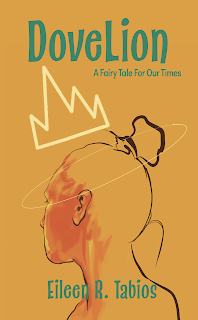
I'm pleased to share a unique review of my first novel DOVELION for situating it within "Indigenous Futurism." You can see the review HERE but it pleases me so much that I’m just reprinting below:
Transmotion Review by Denise Low of Baker University
(Accessible online through University of Kent’s open access journals site)
Eileen Tabios. Dovelion: A Fairy Tale for Our Times. AC Books, 2021, 309 pages. ISBN: 978-1-939901-19-4
https://www.acbooks.org/dovelion
Eileen R. Tabios' Dovelion is a slipstream work of fiction. It has characters, and a plotline develops, slowly, in the background, like a novel. Some of this work is fictional, some autobiographical. The central site is in an imagined place, Pacifica, which is supposedly connected to the Philippines (where Tabios was born before moving to the United States). But rather than autofiction, the narrative is a work of Indigenous futurism as it shifts among strands of transcolonial experience. "Transcolonial," not postcolonial, is the better term to describe the book's political critique, to suggest how imperial powers have dominated Indigenous peoples like those of the Philippines and how their influence continues and will continue in myriad guises globally. The author is simultaneously a rebel against erasure of Indigenous sovereignty and a visionary who offers new expressions of cultural traditions and personal wholeness.
Indigenous futurisms writers generate literary and other artifacts that revise western European literatures. With her textual inventions, Tabios disrupts the expectations of English-language genres. Poetry, geography, political science, dialogue, prose poetry, culinary arts, visual art critique—all wend their way through the sequential and gradual unmasking of the characters in Dovelion. This is Tabios' method of character development. There is a through-line present in the novel-like book: a Marcos-like dictator and his family terrorize the populace and exploit the environment, until overthrown. Two lovers are children of enemies. The woman's pregnancy results in a child and then grandchildren who commingle bloodlines of the feuding families. Events occur and recur in the narrative fabric, like revisited memories.
Tabios' body of work includes other experiments with form, including invention of the tercet form hay(na)ku. Several of these are embedded within the work: "When I bleed / I camouflage / tears" and "When I weep / I camouflage / blood" (71-2). Each diary-like section begins with a day and month, but no year. The dates are not sequential, but instead seem random. Tabios created a random language generator for her projectMurder Death Resurrection: A Poetry Generator (2018), so the nonlinear system for dates in Dovelion is consistent with the author's modus operandi. Jumbled dates suggest entry into an alternative time, where linear sequence is irrelevant. Like oral tradition stories, the same incidents repeat with varying emphases. Point-of-view shifts among characters. Thus, Dovelion's underlying scaffolding is a three-dimensional clothesline upon which to hang moments of all shapes and sizes.
All entries begin with the fairy-tale phrase "Once upon a time." The chapter entitled "12 April" illustrates one of the unexpected directions of the prose; it begins with reflections on the love affair and proceeds to a quotation from "the poet Eileen R. Tabios," who is, the narrator avers, "a strong influence on my work" (60). The book's narrator and author separate here and elsewhere and re-engage, as Tabios interrogates the act of authorship.
Sequential chapters, one through twenty-five, order the book, an overlay on the randomly dated subsections. And Tabios further divides the book into three overarching sections that create another mapping: "There Was Is," "There Became Is," and "There Will Be Is." English verb tenses collapse into a single tense of presence. Time is a recurring concern of the book.
Decolonization through restructuring of language and genre is one dimension of Dovelion. Another is revitalization of Indigenous values. Tabios writes about her book Murder, Death and Resurrection: A Poetry Generator:
I also wanted to deepen my interrogation (and disruption) of English which had facilitated twentieth-century US colonialism in my birthland, the Philippines. . . . I wanted to develop a consciously closer link to the Filipino indigenous value of "Kapwa." "Kapwa" refers to "shared self" or "shared identity" whereby everyone and everything is connected." (Jacket2, June 2, 2019)
Dovelion defines, explicates, reveals, and dramatizes the timeless value of "kapwa." A "nanny" first explains the term in the book as "despite diversity, One is All and All is One" (57). In another embedded quotation from the author's own writings, she explains a poetics that expands on the meaning of kapwa:
The human, by being rooted onto the planet but also touching the sky, is connected to everything in the universe and across all time, including that the human is rooted to the past and future—indeed, there is no unfolding of time. In that moment, all of existence—past, present, and future—has coalesced into a singular moment, a single gem with an infinite expanse. (DoveLion 60, originally published in The Awakening, 2013)
The author also explains kapwa in terms of the science of physics, explaining that "it's not only a cultural belief. Various physicists have long proposed time is not linear. Some call time a dimension of spacetime and, thus, [time] does not pass because spacetime doesn't" (156). The theory is a praxis. The restoration of the intact, healthy culture is predicted by its onetime existence in the past. The Filipino child's tale "An emerald island sits upon a blue sapphire ocean and both glow under the beam of a 24-carat sun" is a continuous refrain throughout the narration and a continuous expectation.
Islands are a motif in Dovelion, from the invented island country of Pacifica to the Philippines to a "large grey building" where the two lovers meet in isolation. Each individual is a discrete "island" of individuality, which links to others through sex, children, and social relationships. Kapwa links each person. Unspoken is the John Donne poem, "No man is an island," but it is present nonetheless as all writings in all time exist simultaneously in Kapwa time.
Tabios does not allow decolonization principles to devolve into rhetoric without action. Rather, she previews a future where enemies reconnect in alliances against dictatorships. She shows how the restoration of a continuous concept of time corrects the fallacy of linear time, where the past falls off the left-hand edge of the page and can be ignored (like nineteenth-century US treaties with Indigenous nations). Tabios offers options. She recognizes June 12, the day the Philippines overthrew Spanish rule, through an imaginary website June12.com. She restores Indigenous values in new form. Dovelion is a blueprint for further investigations into a future where Indigenous knowledge structures the narratives.
Denise Low, Baker University
Works Cited:
Tabios, Eileen. The Awakening: A Long Poem Triptych & A Poetics Fragment. Theenk Books, 2013.
–––. "Murder Death Resurrection: Another Way for Poetry." Jacket 2. June 2, 2019. Murder death resurrection | Jacket2.
–––. Murder Death Resurrection: A Poetry Generator, Dos Madres, 2018.

The Battle Against Total Erasure: Review by Elsa Valmidiano.
From acclaimed poet, Eileen R. Tabios, comes her epic first novel, DoveLion: A Fairy Tale for Our Times, from AC Books, April 2021, a novel of erotic encounters, political intrigue, meta literary references, and ancestral/indigenous exhumation.
The fictional setting of Pacifica, many might argue, is a caricature of the Philippines itself, recovering from a Marcos-esque regime, or really any country that is still reeling from dictatorship trauma. This could very well include so many countries across the world, where present day’s Jair Messias Bolsonaro comes to mind and his aggressive moves to open up the Amazon rainforest to commercial development, threatening the current homes of Amazonian tribes, just as Ferdinand Marcos from 1972 to 1986 displaced 300,000 Moro people in Mindanao through a combination of “hamletting” and community takeovers, while refining extrajudicial killings against indigenous communities to help foreign mining corporations secure a foothold on their lands. Hamletting is the clearing of an area of an alleged rebel presence and maintaining a military presence to keep them out. Tabios paints such a caricature of Pacifica’s dictator, eerily reminiscent of the former dictator of the Philippines, Ferdinand Marcos himself. As one can additionally see today, despotic power is still evident during Rodrigo Duterte’s reign against the indigenous Lumad. And so the modern fairy tale, or shall we call it modern day history, goes on and on.
As evident in Tabios’ poetic prose, the strategic opening lines do not go unnoticed as she reiterates the echoed lines from paragraph to paragraph, “Once upon a time,” staging an irony as if the events in the novel reveal what is happening now, not far away, but now, so that “Once upon a time” becomes a poetic refrain of a story or song to be repeated and remembered. In its own way, the repetitious lines from her storytelling remind me of Filipino folk songs and ballads I grew up knowing, as if they are memory tools, so that in reading “Once upon a time,” Oral Tradition of our own nuanced ancient storytelling is reflected back at us, not memorialized in spoken word and song this time, but in written text.
Between the erotic and vulnerable exchanges between protagonists, Elena Theeland and Ernst Blazer, Tabios not only captures the intensity of these would-be enemy-descendants, but poses the question, “How do descendants of enemies forgive, love, and move on?” Philippine history itself reveals this repeating betrayal among brown brothers, such as Diego Silang, a young Ilocano revolutionary leader who dared overthrow Spanish rule in the 1760s, and was killed by his own friend whom colonizing authorities paid to assassinate. And somewhere out there, the descendants of victims and executioners possibly coexist—in the Motherland? in the Diaspora? Could they be close friends, even lovers, and not know it?
Tabios’ love story, if we could call it that between Elena and Ernst, would fall under a Romeo and Juliet motif, but one in which Tabios digs even deeper to reveal the political seeds and upheaval that would have made Ernst completely unforgivable in Elena’s eyes, begging the question: How do we escape the sins, hatred, and bitterness of our fathers, and if so, is it possible to work together to overthrow a totalitarian regime?
Tabios also playfully drops meta literary references like hidden Easter eggs throughout her text, where the title itself, DoveLion, the true name of Pacifica before its dictator changed it, also closely resembles twentieth century Filipino poet, Jose Garcia Villa’s pen name “Doveglion,” a combination of the words “dove,” “eagle,” and “lion,” which he believed was his true persona. In another instance, the main protagonist Elena comments on Tabios as if the story existed entirely apart from the storyteller herself. Tabios also plays on names throughout the novel, such as “Baybay” for “Babaylan,” the honorary title given only to the Philippines’ precolonial matriarchal governing high priestesses.
Even as Tabios paints Elena’s naïve love for Wikipedia for research and information, Tabios does not undervalue the weight of magic, dreams, and ancestral knowledge. It appears that kind of knowledge can be innate before resorting to online research and documentation where room for inaccuracy by an unreliable online contributor is always probable and suspect.
As Elena learns she is indeed Itonguk, a fictional indigenous tribe of Tabios’ fictional Pacifica, the novel takes on an interesting commentary regarding the modern Filipino’s own clouded tracing to their indigenous roots as we wonder what makes us different from the indigenous tribes and are we not a part of them, or at least acknowledge that we once were? Just as Ilocana revolutionary Gabriela Silang was not only Ilocano—her mother was Itneg—the protagonist’s own discovery of her indigenous heritage suddenly makes a difference in Elena’s revolutionary fight for the preservation of who we truly are, not just as interracial colonized modern-day products of our white colonizers and indigenous ancestors who have been ruled by a dictator—brainwashed by a colonial mindset—but that there are significant distinctions to be made between indigenous communities so that we may fully understand our own ancestry as well as build solidarity in our archipelago and Diaspora as a whole.
As Elena addresses the spirit of her Itonguk mother, reclaiming her ancestry, identity, and self in the face of indigenous erasure:
“I feel you in that space where there’s no past, present or future—there’s only a single all-encompassing moment where you and I are not separated” (276).
Sans the blood of Spanish and other white invaders like the British and Americans intermingled into our own present-day DNA, it seems Tabios reminds modern-day Filipinos that indigenous blood and magic is who we used to be—or, may I dare say, always are—and that is worth fighting for in not only battling subjugation, but that we do not fall into total erasure and ethnic homogeneity by not knowing exactly our roots.
*****
Elsa Valmidiano is an Ilocana-American essayist and poet whose ancestral roots hail from La Union through her mother and Ilocos Sur through her father. Elsa is the author of We Are No Longer Babaylan, her debut essay collection from New Rivers Press. Her book reviews appear in Poetry Northwest, The Collidescope, and Bridge Eight. Her poetry and prose appear in Cosmonauts Avenue, Anomaly, Cherry Tree, Hairstreak Butterfly Review, among many others. Her work has also been widely anthologized. She holds an MFA in Creative Writing from Mills College and has performed numerous readings. Her work has been nominated for Best of the Net and the Pushcart Prize. On her website, slicingtomatoes.com, Elsa curates a directory of Pinay visual artists from the Philippines and Diaspora whose work she features alongside her poetry and prose.

Marsh Hawk Press recently concluded a virtual book launch reading series featuring current Marsh Hawk titles by Jon Curley, Thomas Fink and Maya Mason, Edward Foster, Basil King, Daniel Morris, Gail Newman, Geoffrey O’Brien, Eileen R. Tabios, and Tony Trigilio. Before each reading, Burt Kimmelman presented a much-applauded, insightful introduction to the poets' works. These critical intros are now collected in a summer edition of the Marsh Hawk Review available HERE.
I am blessed by what Burt had to say about The In(ter)vention of the Hay(na)ku, including the following:
Too many readers overlook a poem’s form, ironically. Tabios does not. Yet she’s always bending it. Tom Fink points out, in his introduction to The Intervention of the Hay(na)ku, that this book “involves theorizing about poetry [from] within the poems.”
James Joyce found poetry too confining. Tabios must always transcend her own formalisms—their own magnitude and brilliance. What one writer lives in or with, so the other.
Tabios is intrinsically drawn to form for reasons to do with how aesthetics and thought touch. Robert Creeley wrote what I see as a hallmark of post-War American experimental poetry. Titled “A Piece,” the poem has five words—two each in the first two lines, one in the last. Its unobvious symmetry is evident in its reading:
One and
one, two,
three.
When once asked about this poem, Creeley said: “I knew that for me it was central to all possibilities of statement.”
Tabios may not know Creeley’s poems well. Nevertheless, she possesses the instinct in that non-poem. I’m awed by her intellect that’s always understated.
*****
What's interesting about this edition of MH Review is that presenting the same critic allows the reader to contextualize each take on a different poet from the same mind--you can consider Burt's opinion on Poet A based, too, on how he approached Poet B or Poet C, etc. There's a certain integrity there that's rarely accessed.
Of course: THANK YOU, Burt Kimmelman!
Summer of Emergence Reading Series: New and Recent Marsh Hawk Press Books
Contents
Introduction
Basil King, Disparate Beasts Part 2
Geoffrey O’Brien, Where Did Poetry Come From; Daniel Morris, Blue Poles .
Thomas Fink and Maya Mason, A Pageant for Every Addiction
Jon Curley, Remnant Halo: A Map n’ Dice Chronicle
Eileen Tabios, The Intervention of the Hay(na)ku: Selected Tercets
Gail Newman, Blood Memory
Tony Trigilio, Proof Something Happened
Edward Foster, A Looking-Glass for Traytors
ABOUT BURT KIMMELMAN


Deep gratitude to reviewer Ray Gleenblatt and North of Oxford for reviewing DOVELION. The reviewer focuses on the book's diction and his focus is why I don't mind talking a lot about the novel's plot ... because nothing said can replace reading the book. One doesn't get this novel by reading about it but only actually reading it, unmediated. You can see entire review HERE, but here are some excerpts:
Tabios has the skill to bring objects to life, whether miniscule or cosmic. Let us first look at the building in which Elena and Ernst meet. “A building that looked like a grey egg. I cracked it open.” (19) This simile suggests the birth of something significant. “The building’s multiple reflections encouraged the thought of parallel universes.” (33) Inside this structure all types of freedom of expression waited for her. Through direct address she challenges her fears: “I am not small and anonymous like you, Basement!’” (31)
[...] Not much has been said about the author’s moments of comedy.
“Capturing light through algebra.” (284)
“Anthologies of glass.” (285)
I am not quite sure what the above mean, but I find them delightfully whimsical. "


Neil Leadbeater reviews DOVELION: A Fairy Tale for Our Times for The Halo-Halo Review. You can see entire review HERE, but here are excerpts:
True to most fairy tales, the novel opens with the traditional phrase “once upon a time” but there is nothing traditional about this novel which is at once inventive and experimental. How many times, for example, can a writer get away with describing a young woman approaching a threshold and pressing a button on an intercom to gain entry to Apartment 3J? The answer is again and again and again. Each time the reader is given a little bit more information and each time the reader is kept in suspense. There is something portentous, if not symbolic, about crossing a threshold. Tabios takes this to new heights by exploring the threshold of pain: how much a human being can withstand pain through living with actions that can have long-lasting repercussions. The repetitive, formulaic patterns seen in Part I recur in Part II “leaving darkness for light” and in other chapters where “a dictator made me an orphan. To be an orphan is to be unsure” and in Part III “Once upon a time I woke up and I was old…” These mantras punctuate multiple arrivals. The use of repetition applied in different forms throughout the novel is akin to the musical equivalent of a set of variations on a theme.
…
Helpful, informative notes are supplied at the end because “all stories bear appendices, notes, footnotes and postscripts” and this one is no exception. Cleverly put together, this novel will appeal to all those who are interested in autofiction and its future as a literary genre.
In the same issue, Ayo Gutierrez shares some of the "posters" she is making from her favorite lines in the novel. Here are two below; you can see the rest HERE.


My miniature book, the 2-3 inch WHAT COUNTS unexpectedly get its first review and I’m delighted as it’s from miniature book expert/collector/publisher Todd Sommerfeld of Booksby Press. I appreciate it as O Henry’s story is a long-time favorite and what a treat to have written a short story likened to “The Gift of the Magi”!!


Well, a book I released but deliberately didn't try to market, INCULPATORY EVIDENCE nonetheless receives attention--and I can only be grateful.
Deep gratitude to Neil Leadbeater for a review at North of Oxford. You can see review HERE but here's an excerpt:
The subject matter in this volume goes wider than Covid 19: ‘Regret’ focusses on the environment, ‘Triggered’ on hunger, ‘Not My First Mask’ on xenophobia and racism and ‘What I Normally Would Not Buy’ on panic buying, consumerism and survival. This is not just physical survival but also survival from domestic abuse.
Tabios uses food in this collection as a metaphor for survival. Food, in its various forms, appears in at least seven of the ten poems. We cannot survive without it. Witness the panic buying that took place as soon as news of the outbreak spread. Maslow was right when he included it within his hierarchy of basic human needs (although he seems to have overlooked toilet paper altogether).
As well, I and Rosalinda Ruiz Scarfuto--who'd also come out with her own Covid-19-related book (she survived the coronavirus)--engage in a discussion about our projects which is featured at Otoliths. You can see our conversation, "Evidence and Survival," at the link but here's an excerpt:
Ecopoetics is useless unless one is actually doing something about it in addition (perhaps) to writing about it. One recycles, one minimizes one’s footprint on earth, one supports initiatives that diminish our (ab)use of natural resources, one educates, and so on. As regards the latter, my poem “Regret” is an example by raising how, out of concern of viral transmission, the use of plastic bags has risen during the coronavirus and “plastic bags// adrift in the ocean require/ up to 20 years to decompose.”

Grateful to Denise Low for interviewing me about my new short story collection PAGPAG. In the same feature, Neil Leadbeater provides a review, for which I'm also thankful. Here are excerpts below, but you can see both interview and review HERE.
These stories (except for one I added to cohere the collection) were published from 1995-2000; they represent me as a newbie creative writer, and I do not write the way I wrote back then. But I decided to re-issue them as a book in protest against the cruel policies of current Philippine president Rodrigo Duterte as well as his complicity in rehabilitating the reputation of the family of Martial Law dictator Ferdinand Marcos. I thought it important to remind people that Martial Law occurred, was damaging, and offers a legacy wherein junior-Marcos-type politicians undeservedly thrive to the detriment of the Filipino people they are supposed to serve.
from Interview with Denise Low
Throughout this collection, poverty is described in all its forms and not just in terms of a lack of money. It is also seen with reference to a lack of opportunity and, more importantly, a lack of being able to make one’s voice heard and a lack of being able to do anything about it. There are old men and women sleeping on hard surfaces, small farmers forced out of business, companies stripped of their assets and a displaced population from Calauit who end up dying of starvation....
There is plenty of variety too, ranging from the politically charged “Force Majeure” and “Redeeming Memory” to the politically correct “Homeland” and the comic “Pork” and “Tapey.” Ghosts are present in at least three of these stories, but there is a sense in which they haunt every one of them as Tabios confronts her past.
from review by Neil Leadbeater

The book is well organized and the subjects are broad but spring from specific symbols that work both logically and figuratively. Poems vary from three lines to many pages. There is good variety, a little instruction and much to be discussed in this prism of poems that shares so much light.

Between 1995 and 2001 Eileen wrote protest stories against Marcos’ martial law, and now she shares those stories and more with her readers, revealing the horrendous conditions as viewed through children’s eyes. Noting that these stories are reflections of an ‘ex-patriot’ gives a new insight into the history of the political climate as viewed from afar – a more insightful blend of memory and history that makes her stories all the more compelling. Hunger in the face of the need to scavenge for discarded food, the need to change, moments of introspective humor – all these tales add to the impact of this excellent collection of short stories.”


In poems like “Email to a Young Poet of Color,” “The Now of Heaven,” and “Eco Echo,” Tabios doesn’t shy away from blunt reactions to the political and environmental struggles we face. She writes, “As if the ill-educated parent / will not bear ill-educated children. As if billionaires would / still contribute to charities without tax-deductions.” The collection is strikingly frank. “The Optimists Ciphertext” quips, “Clarity, as lives of quiet / desperation imply, is untrustworthy.” Readers follow the speaker as she searches for something more reliable than clarity. The poems focus in and out on current culture from a precise but unforgiving angle.
Overall, the collection reads like a social proclamation, one many will champion, though others might read as deliberately deadpan. Fans of Ashbery’s Portrait will likely enjoy the echoes of his work paired with Tabios’s take on the vantage of the convex mirror. In short, Witness in the Convex Mirror offers a biographical approach to poetry from a successful and well-published poet.By the way, WITNESS IN THE CONVEX MIRROR is available through this very worthwhile fundraiser at Brew & Forge. Go HERE to get a copy while supporting a great cause!

"One gets that sense that, as free-ranging and transdisciplinary as Tabios is (and she must be to generate so much fresh and innovative text), that she is equally as intimate with these self-same subjects. One can feel the arc of the original inspiration, the spiritual depth-diving with which she engages said subjects to such an extent that the silver thread that holds them is taut enough to pluck and hear the tone as though it were the Music of the Spheres manifestly made.
So make no mistake—Tabios is not innovating and recycling to mask a lack of writing power. Take this tercet, from “listening to what woke me”:
in the city, as summer evaporates off the streets
the stilled, sharp blades of a three-pronged fan
behind the curve of its grated metal mask (27)

