Eileen R. Tabios is a poet working in multiple genres and in-between. She also loves books by writing, reading, publishing, critiquing, romancing and advocating for them. This blog will feature her bibliophilic activities with posts on current book engagements and links to her books and projects related to books.

Wednesday, October 14, 2015

EDITING THROUGH THE LIVE READING -- THE WORKING LIFE!

I was blessed to participate in a Kelsey Street Press reading last night ('twas part of a series curated by Mg Roberts for Intersection of the Arts--an Event Report HERE).  At that reading, I read a new long poem which I described to be a poem I would be "inflicting" on the audience. I used "inflicting" because part of editing a poem sometimes involves reading it out loud, preferably to an audience, and so the poem I shared necessarily was unfinished (yes, poems are never finished but that's another story).  I read "The Secret Lives of Punctuations" (working title) from my HIRAETH manuscript; as a result of the reading, here are some adjustments:

--deletion of two "The"s from two lines (in a poem, each word must be necessary)

--deleted the word "its" from a line as the possessive was already obvious

--deletion of last three words in the line "Waiting out the ash in one's mouth until morning dawns"; "until morning dawns" diluted the desired rhythmic pace and is clichetic

--adjusted the order of a line to move it above what had been a preceding line

--changed the word "sea" to "ocean" as reading it out loud made me realize the "sea" rhymed with "see" in an unwanted way

--deleted the line "Wave of grasshoppers blocking the view of a headless Buddha" because the image suddenly seemed a cliche (the definition of cliche can be subjective--this may be one--but it seemed such to me)

I hope the audience wasn't tortured ...


Friday, October 9, 2015

NEXT UP! THE CONNOISSEUR OF ALLEYS

Did a lot of work this week for my next book, THE CONNOISSEUR OF ALLEYS, forthcoming in Spring 2016 from Marsh Hawk Press.  Maraming Salamat to

Michelle Bautista, Book Designer

Vince Gotera, Author of Foreword

Sandy McIntosh, Managing Editor of Marsh Hawk Press

Advaita Patel, artist whose work will grace the front cover and who also created a painting inspired by the poems in the manuscript.

Busy week -- but I wouldn't have had it any other way!

*

As well, thanks to Raymond Farr whose brand new journal -- I love celebrating new poetry journals! -- The Helios Mss presents one of the poems from THE CONNOISSEUR OF ALLEYS: "Crucial Bliss Epilogues."


Thursday, October 8, 2015

THE POET'S MILE-YARD STARE ...

I found myself, over two days, watching both volumes of George Quasha’s “poetry is (Speaking Portraits)”.  Here’s link to Volume 1 and here’s Volume 2. ’Twas fascinating—I kept wanting to stop (very busy over here) and/or waiting for the boredom to come.  But ultimately I found it difficult to avert my gaze. The series’  basis includes close-ups of the poets’ faces as they discuss what “poetry is” … and I was fascinated to see how, in trying to articulate poetry, many gave a sense of being overcome by “poetry” such that many faces lapsed to, as they say, the mile-yard stare … except it’s inward.  Is that why I try to be nice to poets? Because I feel sorry for them, for us, all?  P.S.  A pleasant surprise to hear Robert Kelly say, among other things, “All a poet ever has to do besides being a very good person and feed, as Olson said, a lot of sugar cubes to a lot of horses...is to let language happen.” Focused on the pre-punchline.  Less than a handful of poets, I think, discussed goodness … and yet perhaps that’s what’s found — what’s staring back — at the end of … that mile-yard stare:

“Have you been a good person?"

With what I've taken away from the series so far (Volume 3 is in the works), Volume 2 concludes synchronistically with a church hymn from my childhood, hummed by Torben Ulrich.  I would not have expected such ... but take me to church!

For me, there could not have been a better video ending to what "poetry is" -- that sounding from this Danish artist, then his beautiful smile, then "That's it!":


Wednesday, October 7, 2015

EPIGRAPHED!


It's rare for many poets to see the impact of their work. So I was heartened (and pleased as punch!) to see one of my poems from a 2006 book, The Secret Lives of Punctuations, Vol. I, recently excerpted for an epigraph in a 2014 book, Mg Roberts' debut poetry collection, not so, sea from Durga Press:


I've since read not so, sea and found it wonderful -- I heartily recommend it! I was delighted to acquire it through the recent 3rd Filipino-American International Book Fest (see prior post).  And speaking of books, here's an update on moi Recently Bought Poetry List of books by poets or about poets/poetry or including poetry: 


M TRAIN by Patti Smith

NOT SO, SEA by Mg Roberts

TO LOVE AS ASWANG by Barbara Jane Reyes

COLLECTED VERSE by Nick Joaquin

THE BEAUTY OF GHOSTS by Luis Francia

EVERYDAY THINGS by Fidelito C. Cortes

PRIME TIME APPARITIONS by R. Zamora Linmark

HOLLYWOOD STARLET by Ivy Alvarez

IT’S NO GOOD by Kirill Medvedev

THE PAJAMAIST by Matthew Zapruder

OCCUPIED by Carol Mirakove

MEDIATED by Carol Mirakove

EVERLASTING QUAIL by Sam Witt

ALL HAT, NO CATTLE by lars palm

SIMPLIFIED HOLY PASSAGE by Elizabeth Robinson

SWARM by Jorie Graham

FLIPS 2015: A FILIPINO AMERICAN ANTHOLOGY (a reprint) edited by Serafin Syquia and Bayani Mariano w/ new introduction by Juanita Tamayo Lott

BEYOND LUMPIA, PANSIT and SEVEN MANANGS WILD, edited by Evangeline Canonizado Buell

BURYING THE TYPEWRITER, memoir by Carmen Bugan

LAST [TRANS] MISSION, wordless story by E. Steen Comer and art by Trista Musco


Sunday, October 4, 2015

BIG BOOK WEEKEND FOR FILIPINO LITERATURE!


At Third Filipino-American International Book Festival with Karen Llagas (2nd from left) and starting with 5th from left, Edwin Lozada, Cecilia Brainard, Eileen Tabios, Luis Francia, Barbara Jane Reyes, Erin Kelly, Nikki Alfar, Lisa Suguitan Melnick and Dean Alfar.

***


Big Book Weekend! Above is a shot of just some of the books I picked up at the Third Filipino-American International Book Festival. Karma smiled as I discover when reading through the first book of the pile, Mg Roberts' not so, sea that one of my poems is excerpted into an epigraph next to a quote from Helene Cixous-woot! 


And let me not forget to mention picking up four promised reviews for the next Halo-Halo Review!  Anyway, here are some photos from the Book Festival as I womanned the Meritage Press Book Table with the fetching assistance of Michelle Bautista's daughter, Gabriella:


(Karen Llagas with her book, ARCHIPELAGO DUST!)


(Poet-fictionist Oscar Penaranda with a copy of VERSES TYPHOON YOLANDA!)

(Poet Amy Pabalan peruses Meritage Press' books!)

P.S.  SUN STIGMATA apparently has many suns ... as it should:


Wednesday, September 30, 2015

HIRAETH: TERCETS FROM THE LAST ARCHIPELAGO

A new poetry manuscript. But of course. This one entitled

HIRAETH
Tercets From the Last Archipelago

I like this definition (which was introduced to me by one of Melissa Sipin's FB posts (salamat! Sometimes FB is useful):


As the title indicates, the poems -- or it could be a single, book-length poem (don't know yet) -- are all written viz tercets.

HIRAETH also reminds me of British artist Andrew Bick's paintings, specifically an older series I fell in love with wherein he paints on "wax" layers.  Here are some (crappy) IPhone photos of some of his works to illustrate how I feel he made art the way I created the poems in HIRAETH: through layers.  If I understand his process right, Bick poured a layer of wax (or something wax-like) and painted on it; after the layer dried, he poured another layer and painted on it again, and so on.  The result is a thickened surface where each layer is transparent enough to reveal the earlier brush strokes.  Here are two examples with which I've enjoyed living for years:


Those square patches of non-transparence are, IMHO, panes of genius: in life, there will always be things that remain forgotten or stubbornly incomprehensible, di ba?  Here's a drawing that's part of this series and which I found witty and innovative for its material: he made a drawing and then slipped it in a wax paper bag to evoke the same sense of transparence but with the fuzziness of memory and/or intellect (of course that black panel is smart!):


All of this surfaced organically from the pot ever-brewing within me -- the poems, and their ekphrasis inspiration, arising with no conscious intent. This poet's job? To go with the flow with whatever overflows from prior living -- poems allowed facilitated by getting out of the way....


Tuesday, September 29, 2015

ON NAVIGATING THE EDUCATIONAL LANDSCAPE THAT IS NOT A "LEVEL PLAYING FIELD"

Becoming a parent nearly seven years ago by adopting a 13-year-old also exposed me (for the first time in three decades) to the state of education in the U.S.  I was shocked. Appalled. I'm a public school kiddo and the deterioration in quality from my time to the current is discernibly steep.  And all in the context of unequal educational quality across the country as enhanced by the widening rifts between the poor and the wealthy (among other things). After all, the privileges of wealth translate to better tutoring, more diverse extracurricular activities, and better resume-bolstering activities such as unpaid internships.

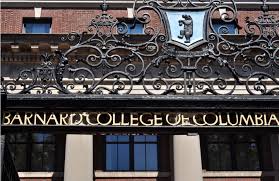
And so I want to share a letter I had sent to the president of my alma mater, Barnard College.  I received a lovely reply yesterday which made me think to share this letter, in part due to the statistics inclination (through standardized tests) of many college applications; I edited out, for privacy reasons, some paragraphs related to my son.

*


Dr. Deborah Spar
President, Barnard College
3009 Broadway
New York, N.Y., 10027

Dear Dr. Spar,

            Years ago, you wrote an article in the Barnard Alumnae Magazine (BAC), the only article ever to remain in my memory (that’s become a colander over time). You wrote about “Tonya,” a student who had applied to Barnard and came from circumstances (poverty, poor quality of pre-college education, among others) that made you worry whether she would be prepared for Barnard’s academic rigor. I hoped then that Barnard, indeed, would accept her …

            Then, through the latest issue of BAC, I see that Barnard did accept her and that Tonya has successfully graduated from Barnard! No words can capture my immense gratitude to you and Barnard for that decision. THANK YOU!!!  Any institution of higher learning certainly should be aware of the structural constraints and un-level landscape that is American education and I’m glad that Barnard was/is sophisticated enough to wo-maneuver through that terrain.

            [...]

  I suppose Tonya’s story is close to my heart as I count myself among the underprivileged kids who applied to college. In looking back at my younger self, I remember—and sheepishly admit to Barnard through you for the first time—fulfilling the required foreign language exam by taking the Russian test. I knew not a single word of Russian. But I remember thinking as a high school student that my Spanish test results were not likely to be stellar (I have difficulty learning foreign languages), so I thought then that I may as well offer a poor test result in a more impressive-for-being-unusual language relative to Spanish which nearly everyone I knew in California was studying. Whether or not that strategy greatly improved my chances, I look back at that younger self and admire her for trying to think out of the box—it is a type of “street smarts” that also made me survive college to be a proud Barnard College graduate today.

I believe more institutions of higher education should be looking for those elements (beyond statistics) that may make a student survive if not thrive in an academic setting. I am so glad—and proud—that Barnard College is this type of an institution, particularly given what you call the “great and tragic divide” that is the country’s educational landscape.

I was a mediocre student at Barnard as I (perhaps mistakenly) privileged my journalism extracurricular experiences to academics.  But Barnard did prepare me well for the world.  That is why I am sending you two of my poetry books,  two Selected Poems projects.  I don’t mean to force you to read my poems (you don’t have to read them!)—but I did want to share the books as physical proof more than 30 years later that when colleges make decisions along “The Right Stuff,” as you’d entitled your latest article, it is a good investment.

By the way, like Tonya, I was also a recipient of generous financial aid…

Again, thank you for myself and for Tonya.  And because Barnard educated me to be part of the world, thanks to Barnard as well for giving me the insight to have, today, a son—my only child. On his behalf, thank you for helping him achieve his potential through family and education.  What we do can have such wide-ranging ramifications, and I am truly grateful to Barnard College for what it does.

Sincerely,

Eileen R. Tabios