
Saturday, December 31, 2022

Monday, December 26, 2022
SIMMERING (A NOVELLA-IN-PROSE-POEMS)
And for my last 2022 book, I'm delighted to release SIMMERING (a novella-in-prose-poems) from Otolilths! More information (including for orders) is available HERE.
Book Description:
Simmering is comprised of 25 prose poems carved out of Eileen R. Tabios’ novel-in-progress, COLLATERAL DAMAGE: A Literature With No Minor Characters. While each poem was written individually and joined randomly, together they create a novella as a narrative surfaces through the rub of language. Each of the prose poems also was written in response to opening lines from some of the greatest English-language novels as written by Jane Austen, Charles Dickens, William Faulkner, George Orwell, Vladimir Nabokov, Alice Walker, Albert Camus, Zora Neale Hurston, Ray Bradbury, Edith Wharton, Raphael Sabatini, Margaret Atwood, Graham Greene, Anne Tyler, William Gibson, Jeffrey Eugenides, Gertrude Stein, Ralph Ellison, William Gaddis, Gilbert Sorrentino, Carson McCullers, G.K. Chesterton, and Laurence Sterne.

Saturday, December 17, 2022
WILL ALEXANDER'S DIVINE BLUE LIGHT
[Click on images to enlarge.]

I was rocked again by the sophistication of Will Alexander’s poetics when I read his transcolonial Preface to his newest book, DIVINE BLUE LIGHT (City Lights, 2022), where he mentions “nanogram.” I’d long heard the term surrealist applied to his work; while I see its logic, I empathize more with blurber Jeffrey Yang’s assessment —Alexander’s poems are “not surreal escape but vibrational engagement.” That vibration can redeem even subjects that can drag, e.g. Alexander’s biographical poem for Pessoa, “Condoned to Disappearance” whose first page I show below at end of review. One could be dragged down easily by (banal) biographical elements but his poem insists instead on “poetic infiltration according to the sound of anonymous hives.”

(Based on that same Preface, I apply the term “transcolonial” which I use for postcolonial work that transcends the colonial context. The idea of upending what Alexander calls “prior lingual aristocracy” speaks to me as a Filipino writing in English.)
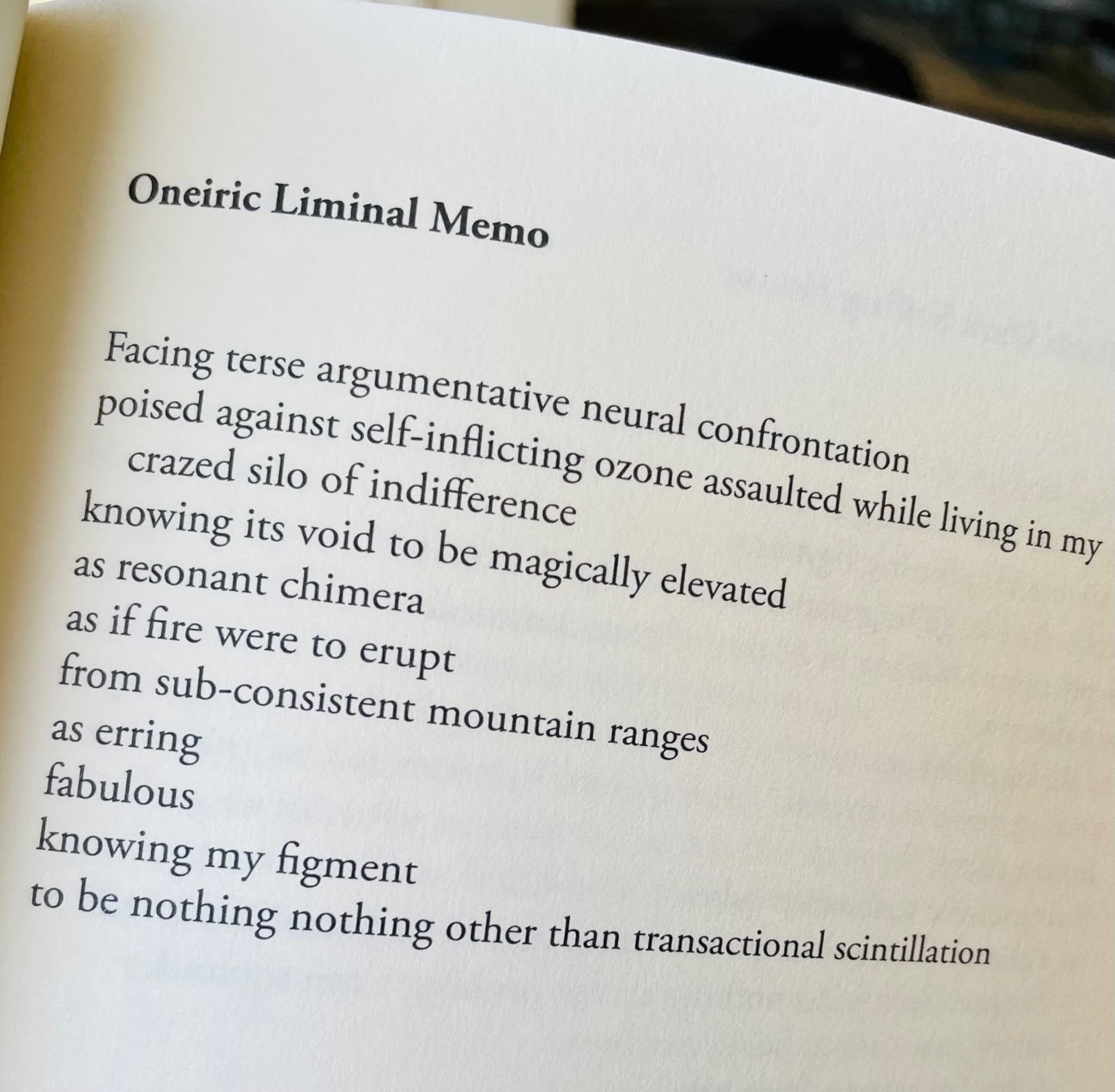
Alexander’s language results in diamonds valuable not for the stones but for the manner in which they are cut. Each facet reveals a light able to exist only through Alexander’s diction. The effect shows up well in such shorter poems as “Inner Palpability” and “Oneiric Liminal Memo” (see images below). The latter is clearly a very personal poem made off-putting to the reader not used to this heightened vocabulary but then pulled to join intimately through the (perhaps wry) paradox of the last two words “transactional scintillation,” a phrase that after all concedes the role of anothers.
Still, I feel Alexander’s prowess shows most in longer poems that must maintain the paradoxical charisma of his unique vocabulary—words that retain a distance through an unsparingly nonnormative diction. It’s also where the multiplicity and variety of his pre-poem homework shines.
By being so textually and texturally muscular, I also feel the strength of the line breaks in Will Alexander’s poems. So I was intrigued by a prose poem, “Nervous Incomparable Dictation.” What would be significance of a prose poem form to Alexander? Well, for this poem, the form was required by its ruminative nature: ruminations that require space for uncertainty vis the thinking-out process that require the breadth of the sentence versus the definitiveness of the manner in which a line is cut or broken. The poet here may be nervous (per first word of title) but he’s certainly got nerve.
Energy, the vibrancy of vibratory currents, might be the ultimate test. That is, read any poem out loud and you’ll feel a sonic transportation that transcends meaning. These poems empathize with body and musically transport. Try it with “Human Presence That Lingers As Distorted Molecule” (see below). I am reminded yet again by how, years ago, I read one of his poems during a City Lights reading. It was the first time I’d read a Will Alexander poem out loud. It was, uh, surreal—by the end of the first line of that poem, I felt my body transformed into a physical instrument for sharing the dynamic energy contained within that poem’s lines.
I was so affected by the experience that when I later walked out of City Lights, I did so without paying for the Will Alexander book from which I’d read. Yes, for Will Alexander I stole a book. I did email City Lights afterwards with apologies and promise to pay (they probably laughed as they said, No problem). Someday, I will repay my debt—and not just for the book but for the pleasure the poems provided. Salamat, Will Alexander.



Wednesday, November 30, 2022
BACKSTORY TO "THE RETURN OF DOVELION"
There's a poem in my novel DOVELION entitled "The Return of DoveLion." I thank Christal Ann Rice Cooper at ART & HUMANITY for interviewing me about the poem for its series "Backstory of the Poem." The series uses copious illustrations so that the article ends up featuring Jose Garcia Villa, my "Murder Death Resurrection" Poetry Generator, Kapwa, my doll-avatars in the writing studio, anonymous readers in Budapest, among other things, as illustrations. I actually had forgotten how many layers there were to the poem (which is also featured). I hope you have time to read it; it's available HERE.

Wednesday, October 5, 2022
READING POETRY BY OVERCOMING BARRIERS AND DEEPENING ENGAGEMENT
To be officially released this month is Thomas Fink's Reading Poetry with College and University Students (Bloomsbury Academic, 2022). More information at the publisher's BOOK LINK. I am grateful for joining a new category of "FINALLY: I'M IN A BOOK WITH JOHN "No man is an island" DONNE!" Tom Fink, the author, is one of our most trustworthy poetry critics today and I would recommend any of his insights. This book is meant for teachers but I'd think it'd be of interest to poetry lovers, specifically those who give meaningful and deep attention to the art..

Julia Alvarez
Amiri Baraka
Tom Beckett
Gwendolyn Brooks
Rosario Castellanos
John Donne
Denise Duhamel
Paolo Javier
Yusef KomunyakaaTimothy Liu
Audre Lorde
Sheila E. Murphy
Trace Peterson
Adélia Prado
A.K. Ramanujan
Adrienne Rich
Evie Shockley
Wisława Szymborska
Eileen R. Tabios
Gail Tremblay
W.B. Yeats
FROM THE PUBLISHER:
Reading Poetry with College and University Students aims to help faculty foster students' intellectual and aesthetic engagement with poems while enabling them to sharpen critical and creative thinking skills. Reading authors across history and the globe--such as Julia Alvarez, Amiri Baraka, Gwendolyn Brooks, Mahmoud Darwish, John Donne, Paolo Javier, Yusef Komunyakaa, Audre Lorde, and Wislawa Szymborska--Thomas Fink zeroes in on how learners can surmount and even enjoy tackling the most difficult aspects of poetry.
By exploring students' emotional identification with speakers and characters of poems as well as poets themselves, Fink shows how an instructor can motivate students to produce effective and empathic interpretations. Through divergent readings of selected poems, the book addresses the influence of various theoretical paradigms, ranging from ecological, psychological, feminist, and queer theory to deconstructive, postcolonial, and surface reading orientations. Instructors receive practical guidance through these poems, poets, and modes of reading, helping to give learners raw material to reach their own nuanced interpretations and strengthen their emotional, aesthetic, and intellectual acumen.
Tuesday, July 26, 2022
WELCOME, PRISES!
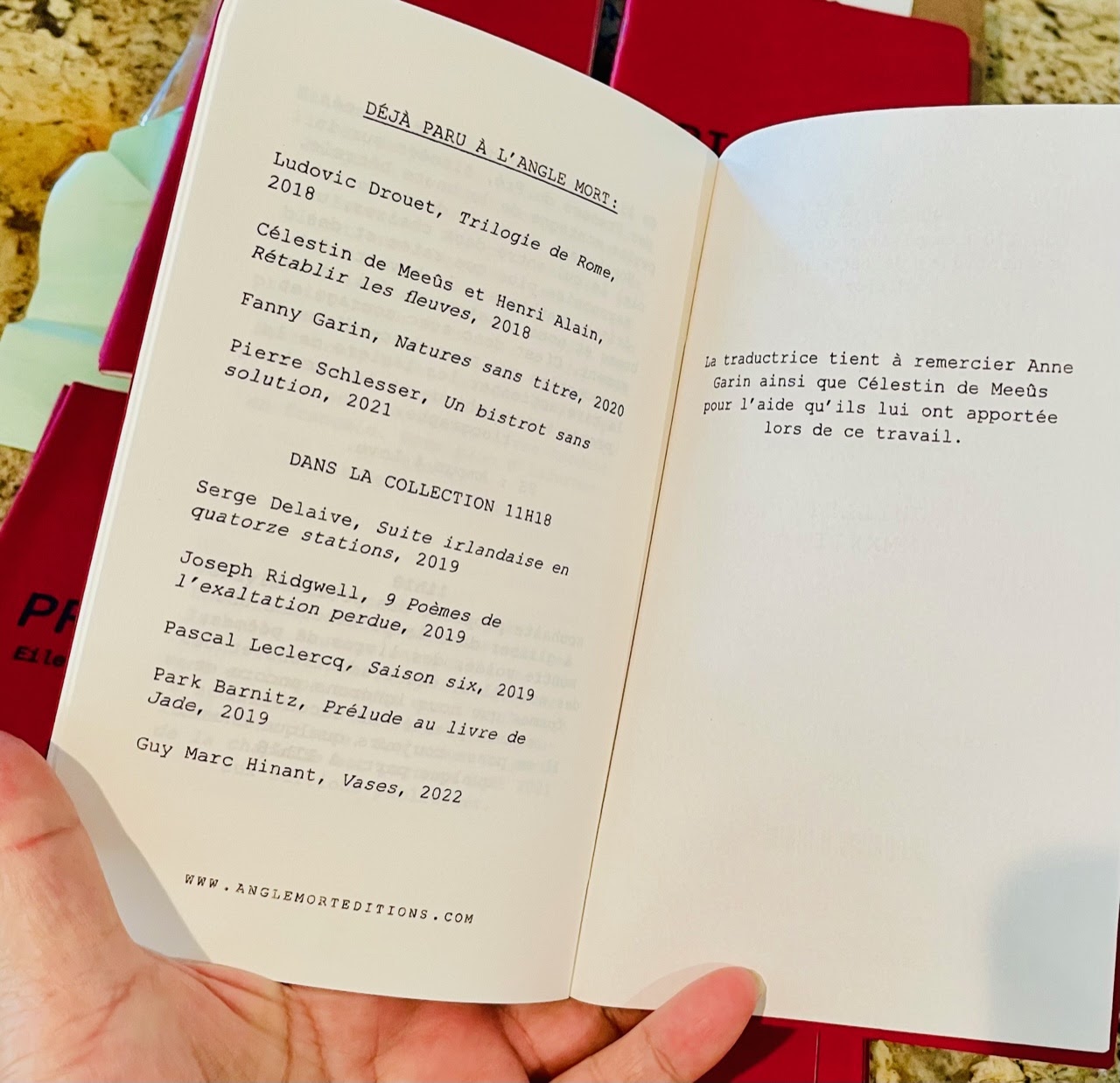
From a "green and lost" French countryside in Morvan Heights, Angle Mort Editions sends the first book printed at their workshop there: PRISES, my second 2022 book and second translated-to-French book. I'm deeply grateful to translator Fanny Garin, editor Celestine de Meeus, and the sharp printmakers of Angle Mort Editions for this superbly refined letterpress edition. More info on book is at at these links:
and
Here are the obligatory and chronological opening photos of my official author copies. Last image features PRISES newly on my writing desk, guarded by my novel's spy-avatars. Merci beaucoup, Univers.



~~
Letterpress printing on Fedrigoni paper for the cover. Risographic print on Olin Rough paper for indoor use. Printed and assembled by the editors at the Presses du Pré. A fabulous video on making PRISES is available at https://www.facebook.com/watch/?v=800165401395239

Sunday, July 3, 2022
ON DOVELION, NOVEL-WRITING, AND, AS EVER, POETRY

I'm grateful that my first novel DOVELION (AC Books, New York, 2021) continues to receive attention more than a year after its release. Here are three examples:
DOVELION's book page presents links to reviews and reader-engagements. The latest review that came out today is by Allen Gaborro at The FilAm where he concludes
“DoveLion” does however have a saving grace other than the treasure of its poetry. The book indelibly illustrates the fertile spiritual and emotional struggle and affecting introspection taking place in its text. That’s something that the best of plots cannot accomplish on their own.
I also was recently interviewed by Eulipion Outpost on creative writing, aging, Asian drama bingeing, and dolls. The article is illustrated one of two writing desks in my writing studio:


Subscribe to:
Posts (Atom)