Eileen R. Tabios is a poet working in multiple genres and in-between. She also loves books by writing, reading, publishing, critiquing, romancing and advocating for them. This blog will feature her bibliophilic activities with posts on current book engagements and links to her books and projects related to books.

Thursday, April 30, 2020

UNDOING THE DOG EAR ON OLD BOOKS

Miniature book collecting -- you can see my Tiny Book Library HERE -- has surfaced some book-related issues new to me. One is antiquarian concerns since so many of these lovely Tinies are old books. Recently, I had a conversation with the experienced Book Dealer John Howell about dog-eared pages on old books; I was concerned about whether I should unfold the pages flat before storing the books on the shelves as I feared the folded areas might crack off if unfolded. In response, he said:
Nineteenth-century paper was often manufactured with material that was highly acidic. This produces today paper that is heavily toned or brittle. If the crease is heavy, you want to be careful folding the paper back to its original position, because you will highly likely break off the corner at the fold.  Even with special tools. 
Papers produced before 1800 (as a round number) tend to have been made with sturdier materials - or rather, less acidic materials - and many papers curled or folded can be easily manipulated back to their original position. If the covers are sturdy enough, and given light pressure, the pages will do well to be put back to their original position.
Not only was I appreciative of the education but that's the kind of detail that sends my book-nerd heart palpitating exquisitely with pleasure. So to speak. And he also advised in case I ever want to undo the dog-ear:
Take a slip of paper, say 1/4 inch wide and 1 to 2 inches long. You can slide that little slip of paper under a dog-eared corner, and gently fold the corner back to its original position. Your thumb, finger, or fingernail will not be subtle enough to lift up the corner. But you can do it with a thin slip of paper.
Helpful but also enchanting to learn that!

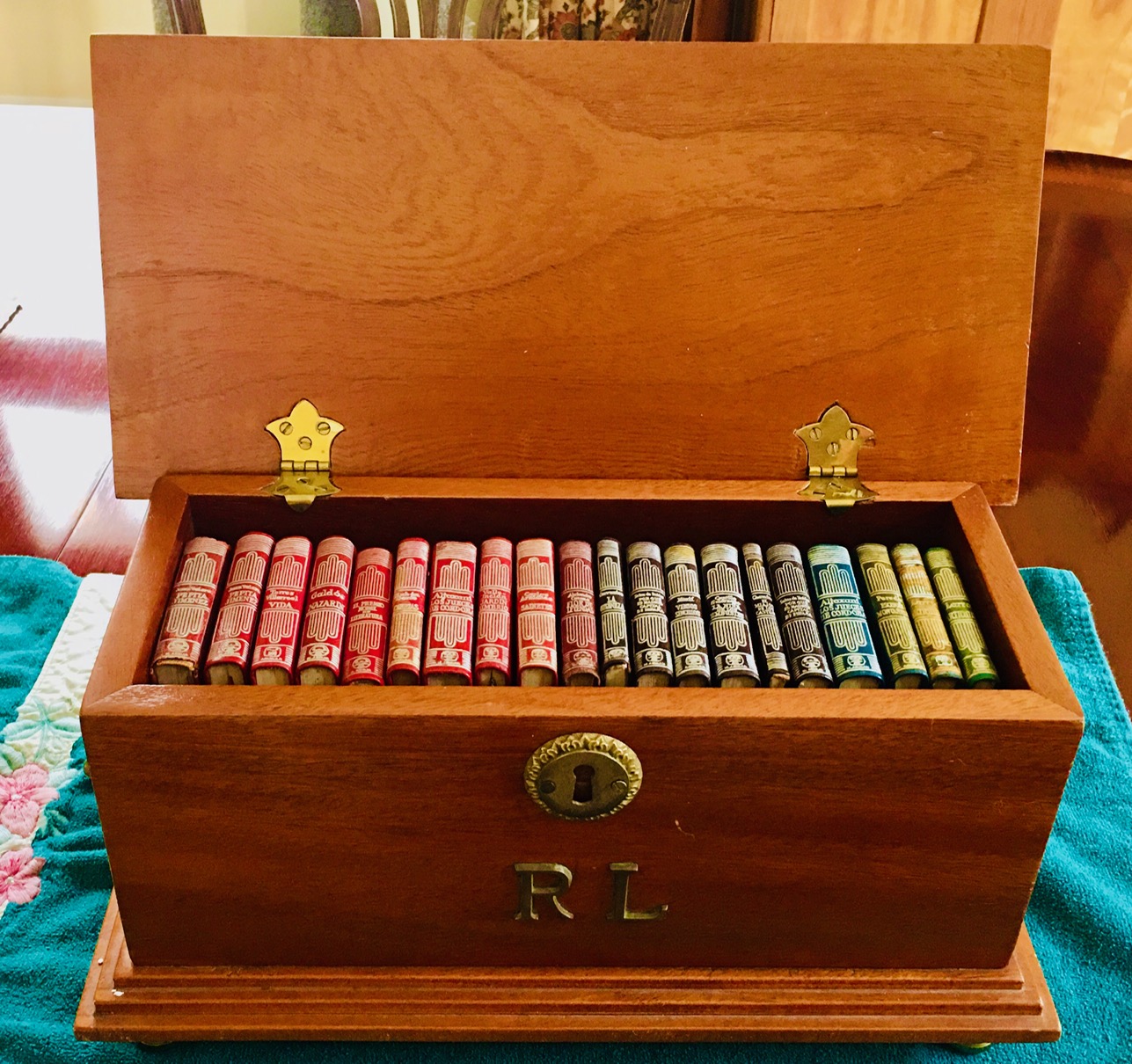
Okay, here are some recently-added old (but not ancient) books -- non-English (which I rarely do as I prefer to be fluent with what's in my library) additions to my Tiny Book Library: Spanish literature!


Monday, April 27, 2020

MERITAGE PRESS--TAKING STOCK

These are the books I've published, in chronological order, through Meritage Press. The first is actually an etchings series since I hoped, when I began the press in 2001, that it would not just publish books but be a space for multiple forms. Not included here are some miniature chaps put out as a Haiti fundraiser and various other projects:


Friday, April 3, 2020

PAGPAG'S ANTI-COVID-19 INITIATIVE

SUPPORT FOOD BANKS: This is a modest initiative to help support foodbanks for which we’ve set aside 20 copies of PAGPAG. For every minimum $20 donation to food banks, whether your local community’s or through Feeding America, you will receive a free, signed copy of PAGPAG.

“Pagpag” is a term applied to food scavenged out of garbage—thus, the book's theme is itself highly-sensitive to issues of food insecurity, a matter just drastically ramped up by the Covid-19 pandemic. New millions are now turning to food banks due to job disruptions and school closures. We hope you can participate in this initiative of supporting those in need of food, even as you add a book to your reading pile to weather shelter-in-place requirements.

This initiative is in line with PAGPAG publisher Paloma Press' belief in "the power of the literary arts, how it can create empathy, bridge divides, change the world." 

You can send a copy of your donation receipt and address to Eileen Tabios through Facebook PM or email at galateaten at gmail dot com


Tuesday, March 31, 2020

NEW BOOKS RECEIVE REVIEWS


Lynette G. Esposito reviews my The In(ter)vention of the Hay(na)ku for North of Oxford. You can see review HERE, but here's an excerpt:
The book is well organized and the subjects are broad but spring from specific symbols that work both logically and figuratively. Poems vary from three lines to many pages. There is good variety, a little instruction and much to be discussed in this prism of poems that shares so much light.
**


Grady Harp reviews PAGPAG for the San Francisco Review of BooksYou can see review HERE, but here's an excerpt:
Between 1995 and 2001 Eileen wrote protest stories against Marcos’ martial law, and now she shares those stories and more with her readers, revealing the horrendous conditions as viewed through children’s eyes. Noting that these stories are reflections of an ‘ex-patriot’ gives a new insight into the history of the political climate as viewed from afar – a more insightful blend of memory and history that makes her stories all the more compelling. Hunger in the face of the need to scavenge for discarded food, the need to change, moments of introspective humor – all these tales add to the impact of this excellent collection of short stories.”


Saturday, March 7, 2020

THE CREATOR OF BOOKS FROM BANNED WORDS


March 2020 presents my one-year anniversary as a miniature book collector. As a writer, it appalls me a little (pun intended) that I didn’t learn about miniature books until just a year ago. But as a long-time lover of miniatures as well as an author, as soon as I learned of miniature books, I glommed on to them. It’s logical, right? But what I did not anticipate is the tension between considering miniature books as objects to look at (and fondle) versus as bearers of texts to read (as books).

Because I’m a writer, I decided from the beginning to take the library versus collection approach, that is, I would choose books that I could actually envision being in my personal library (regardless of the size of the book). This placed some limits in my collecting approach. I don’t, for example, collect miniature journals or books with blank pages—many of these objects are collected for the beauty of their bindings but I require interior material that can be read (while one can “read” a blank page, one blank page is like another so I couldn’t see myself collecting books of blank pages). But, today, I made an exception—I acquired several blank journals made by Sasha Mosolov.

I’m not sure I would have made this exception were the book artist not this native Muscovite who received a Book Arts degree from the Moscow Institute of Graphic Arts. Let me quote from his bio at the American Binders Museum where I discovered him: “Sasha Mosolov … began a bookmaking career as an edition binder at a time when much—perhaps most—literature in the Soviet Union was banned. Mosolov bound photocopies of forbidden texts–Freud and Jung, religious texts, and anti-Soviet literature—in small-run editions. Because bookbinding materials were difficult to come by except through official channels, he developed techniques using cloth, paste paper, and cardboard to create his editions. These techniques became the basis for his unique works, bound in dyed-and-painted leather on which Mosalov fashions textured, raised images. The endpapers are handmade collage designs, and the pages are hand-sewn.”

I love the idea of this underground book binder, as much as I appreciate the beauty of his work. I’m fortunate that many of his keychain-books fit the size constraints of miniature books. I did also acquire a huge tome by him as contrast. I present photos below—you’ll note that the endpapers are also handmade collages. I think a book artist who created books from banned texts should find a home in my modest Miniature Book Collection. Welcome Sasha Mosolov!


The keychain books are sized at 2.75" x 3-18".